Author: Mohammed Rujel

  • How Often Should You Water an Aloe Plant

    How Often Should You Water an Aloe Plant

    If you have any idea about Aloe plants, then you must know that they are not very high-maintenance plants. However, just like every other plant, it does need water so it can survive and grow. The real question is, how much water does an aloe plant need?

    Just some vague details aren’t sufficient for you to be able to take good care of your plant, and if you don’t take good care of your plant, it will undoubtedly die. So, we have written out all the details you need to know about watering Aloe Vera plants in this article!

    What’s The Amount of Water Needed For Aloe Plants?

    What’s The Amount of Water Needed For Aloe Plants

    The first thing we need to clarify is that Aloe plants do not need a lot of water to thrive, so you won’t be having to water them very frequently. The amount of water and the frequency at which you have to water them also depends on the season. 

    When the temperatures are a bit higher, so around spring and summer, you will need to water them more. In these times, the roots of this plant have to be fairly moist. To give you a better idea, you will have to water this succulent about every 2 weeks when it’s a bit hotter and dryer. 

    On the other hand, when the temperatures are lower, you will have to water your aloe plant just around every 3 weeks. Since the watering is very infrequent, you might forget about it. Thus, we would suggest you set a reminder on your phone!

    Irrigation of this plant should not be a matter of large concern for you because they are actually quite strong and don’t die that easily. When you are watering them, you want the water to go deep into the soil. Doing this will help the leaching of excess salts in the soil that the plant is rooted in. 

    You want to keep the soil moist, but in no way should you have this succulent underwater. Overwatering can damage the plant and cause fungal disease in the roots. 

    If you have overwatered your Aloe plant, then don’t worry; you still probably have not killed it yet, and the problem is fixable. You will have to pull out the plant from the overwatered soil and put it inside a new pot of soil after some days have passed. Also, remember to wait a few days to water your aloe plant after you have repotted it. 

    What are the Factors that Affect How Much Water an Aloe Plant Needs?

    What are the Factors that Affect How Much Water an Aloe Plant Needs

    From the previous section, you must be able to tell that the watering needs of an Aloe plant aren’t always the same. There are a handful of factors you need to know about that determine the amount of water that the succulent needs. 

    Indoors or Outdoors

    Aloe Vera plants can grow well indoors in spots where they can receive some sunlight, and it is suitable outdoors as well for the most part. If the weather condition outdoors is very windy, then you may have to water the plant more often. 

    Meanwhile, if it’s very rainy where you live, then, you won’t even need to water your Aloe plant. We would suggest you keep this plant indoors if it rains too much outdoors. 

    Temperature and Humidity

    This plant is adapted to be able to survive in conditions with very little water, and where the temperature is high, so you don’t need to fret about it dying in the heat. However, you will have to water slightly more frequently when the temperature is very high. 

    Humidity also plays an important role in determining how much water the plant needs. If it’s more humid, then the plant will lose less water, so you will have to water it in longer intervals, and vice versa. 

    Pot Size

    If you have the plant in a larger pot, then you will have to water it less frequently because the pot retains more water. On the other hand, pots that are smaller will dry up a bit faster. 

    How Can You Tell if an Aloe Plant Needs More or Less Water?

    How Can You Tell if an Aloe Plant Needs More or Less Water

    It’s quite easy to determine if your Aloe needs more or less water. There are two things you need to examine before concluding. Firstly, you want to take a good look at the leaves. If the leaves seem wilted and become translucent, then you are probably dealing with an underwatering issue. 

    The leaves of this succulent will turn yellowish-brown, and will also appear puffed if you have watered them too much. 

    Next, we have the index finger test. Press down the index finger into the soil, and if it is still moist then don’t water it that day. You must only water the Aloe plant if the soil starts to feel dry. 

    What Are Some Common Problems with Watering Aloe Plants?

    Common Problems with Watering Aloe Plants

    These plants won’t give up on you if you miss watering them a few times, so they are quite sturdy and a perfect choice for people who don’t have much time. The only common problem that plant owners have with the Aloe plant is that they overwater them. 

    This happens because they are used to watering most of their other plants almost every other day. With too much water, the roots of this plant start to rot and develop fungal disease. However, as we have mentioned, this can be fixed. 

    How Can You Prevent Problems with Watering Aloe Plants?

    How Can You Prevent Problems with Watering Aloe Plants

    You don’t have to do too much to take care of Aloe plants. Make sure that the pot that you have planted the succulent in has a drainage hole so that excess water can flow out. 

    Besides that, just keep an eye out on the weather, and check the soil of the Aloe plant every two weeks to see if it has water. That is all you have to do to grow a healthy Aloe Vera Plant!

    Final Words

    By now, it has been made abundantly clear to you that there’s not much to worry about watering Aloe plants. So, how much water do you need to spray on the Aloe plant? The simple answer for that would be that it needs to be watered to be every 2-4 weeks. A slightly complicated answer would be it depends on the external conditions. 

    The rule of thumb with this plant is if you’re not sure how much water to pour in, just underwater, it’s still better than overwatering!

    Related Posts:

    Snake Plant Care: How Much Light And Water is Needed For a Snake Plant

    Can You Use Cactus Soil For Snake Plants?

    Caladium Strawberry Star: All You Need to Know

    Boobie Cactus | All You Need to Know

    Oregano Poleo: All You Need to Know

  • Mastering the Art of Leaf Identification: How to Tell a Tree By Its Leaves

    Mastering the Art of Leaf Identification: How to Tell a Tree By Its Leaves

    A few days back, I was walking through woods and came across a tree with some really interesting looking leaves. 

    At first, I had no idea what the tree was. But I was intrigued and decided to do some research. Turns out, it’s pretty easy to identify trees by leaf if you learn about some basic stuff. 

    And here, I’ll lay out the thing you need to learn to ID a tree correctly.

    The Feature of a Leaf To Observe to ID a Tree

    1. Check Leaf shapes and size

    Check Leaf shapes and size

    Leaf shape can give you a good idea about what kind of tree it is. So, the first step is to look at the overall shape of the leaf. Is the leaf long and narrow, or does it look like an oval? 

    Once you’ve determined the general shape of the leaf, take a look at the individual leaf lobes. Are they smooth or jagged? What is the size and shape of the leaf’s base?

    After you’ve collected answers to these questions, it would help you to narrow down the tree type. 

    Maple tree leaves are large and of rounded shape. At the same time, the leaves of oak trees are long and narrow. And the birch tree leaves are small and oval-shaped. 

    2. Examine the leaf’s Texture

    Examine the leaf's Texture

    For further narrowing down the trees, the texture if the leaf can help. 

    In general, You’ll find 2 main types of leaf textures: broadleaf and needleleaf. 

    The Broadleaf leaves are wider and come with a more textured surface. In contrast, needleleaf leaves will be thinner and feature a smoother surface. 

    However, there are exceptions to this rule, so be sure that you have enough knowledge about the topic.

    Also, keep in mind that texture can also vary due to the age of the leaf. Younger leaves are normally smoother and fresher-looking. At the same time, older leaves can be more textured and worn-looking.

    3. Inspect the stipules (if they are present)

    Inspect the stipules

    Most leaf stalks are adorned with small, scale-like appendages called stipules. Despite their variety of size and shapes, you’ll always find them at the bottom of the leaf. You can identify lots of trees by their distinctive stipules. For example, Oak trees have large, spiny stipules, while maple trees have small, heart-shaped stipules.

    4. Look at the color of the leaves 

    Look at the color of the leaves

    If you want to learn how to identify tree by leaf, color can be a good indicator. You’ll notice that deciduous trees like maples and oaks have bright and vibrant leaves. But the evergreen trees like pines and spruces come with leaves that are darker and of muted colors. 

    That doesn’t mean all the trees follow the same rules.

    Some deciduous trees can have dark leaves, while some evergreens may have light-colored leaves. But in general, the color can give you a good clue about its identity. 

    5. Use pictures from a tree book or online tools

    Use pictures from a tree book or online tools

    Use the pictures online or in a book to find the tree. You can take a picture of the leaf and use google image search to find the tree. Or you can look up the tree in a field guide, or you can use Leafsnap, which is an amazing app for identifying the tree by its leaves. 

    Match the colors, shape, and size with the pictures. That way, you should find the tree name in a fairly quick time. 

    6. Try to find the tree in your area 

    Try to find the tree in your area 

    Another thing you can do is a manual search of the tree. Go around the neighborhood looking for the exact tree that the leaf fell from. Once you’ve found the tree, it will be easy to find its name.

    7. Go to an expert for help

    identifying the tree

    If you have a local nursery or garden nearby, you can take the leaf to them and ask for help identifying the tree. Since they’re expert at this; it will be really easy for them to find out the name of the tree. 

    What Other Methods Can We Try to Find the Tree Name

    Bark

    Bark

    The color and texture can give away the name of the tree easily. And I find this method very reliable when trying to find the origin of a tree. 

    Let me give you an example here. Over the years, I’ve found that cork oak has one of the most unique barks among the trees. The bark of the tree is dark brown and thick, spongy, and hard. Its bumpy texture is caused by the presence of tiny pores in the bark. The eucalyptus tree also has an easily identifiable bark. 

    The bark on this tree is thin, bright red, and peels away in strips. It is easy to identify even from a distance due to its smooth texture and vibrant color.

    So, when finding out the name of the tree in the wood, take a closer look at bark, as it might have all the answers for you.

    Fruits

    Tree Fruits

    There’s a sure shot way to identify a tree; its own fruits.

    I know that not all trees produce fruit, but many do, and the fruit is unique to its tree species. 

    For example, mangoes are only produced by mango trees, while orange are only produced by orange trees. If you learn about the various kinds of tree fruit, you can easily identify the right tree every single time.

    Branches

    Tree Branches

    Branches can be a good way to find out the tree name. Some trees have unique types of branches that can aid you in spotting them. For instance, the Spruce tree has long and slender branches, while maple trees have short, strong, and thick branches.

    Flowers

    Flowers

    This one is a tricky one, but if you can use it properly, flowers can be the most reliable method to spot a tree. Look closely at the tree’s blossoms. 

    Check the color of the petals, how many petals they have, and the shape and size of the flower. 

    Several flowering dogwoods come with small, white flowers that you can witness in early spring. These flowers are replaced by clusters of red berries that provide food. Another tree with distinguished flowers is the Bradford pear, as they come with large, showy flowers in shades of pink or purple. 

    Tree Shape

    Tree Shape

    The tree shape can also be of help to ID the tree. But for that, you’ll need to know what you’re looking for exactly. Like, the palm trees come in multiple trunks, which makes it very simple for you to recognize the tree.

    Summary

    I won’t say that the entire process is easy, but it’s certainly not that difficult either. If you acquire some basic knowledge about the leaves of the trees, you can use them to id any tree. So, getting acquainted with the leaves is your first step in the journey.

  • 9 Fast Growing Seed Plants to Create a Relaxing Atmosphere in Your Garden

    9 Fast Growing Seed Plants to Create a Relaxing Atmosphere in Your Garden

    As we all know, plants need three things to grow: sun, water, and soil. But what many people don’t know is that the first step in growing a plant is planting a seed. 

    Seeds are tiny capsules of life that can turn into trees or delicate flowers. There are thousands of different kinds of seeds, and each one has its own story to tell. 

    Here, we’ll take a look at some examples of seed plants from around the world. Thus, sit back, relax, and get ready to learn about some amazing organisms!

    What You Need to Learn About Seed plants

    What You Need to Learn About Seed plants

    It’s sad that seed plants don’t get the same attention as, say, flowering plants. But seed plants are the foundation of most terrestrial ecosystems. And without them, we wouldn’t have things like trees or bushes or grass. 

    True, seed plants aren’t usually the flashiest members of the plant world. But they’re incredibly important nonetheless.

    So what exactly are seed plants? 

    They’re plants that produce seeds, obviously. But unlike other types of plants, seed plants don’t need water for fertilization. 

    Instead, their seeds are fertilized by pollen, which is carried by wind or animals. Seed plants include both gymnosperms and angiosperms. Gymnosperms are “naked seed” plants, like conifers and cycads. 

    Angiosperms are “flowering” plants, like roses and apples. Most of the world’s plants are angiosperms.

    Seed plants are incredibly diverse, and they play an important role in every country on earth. 

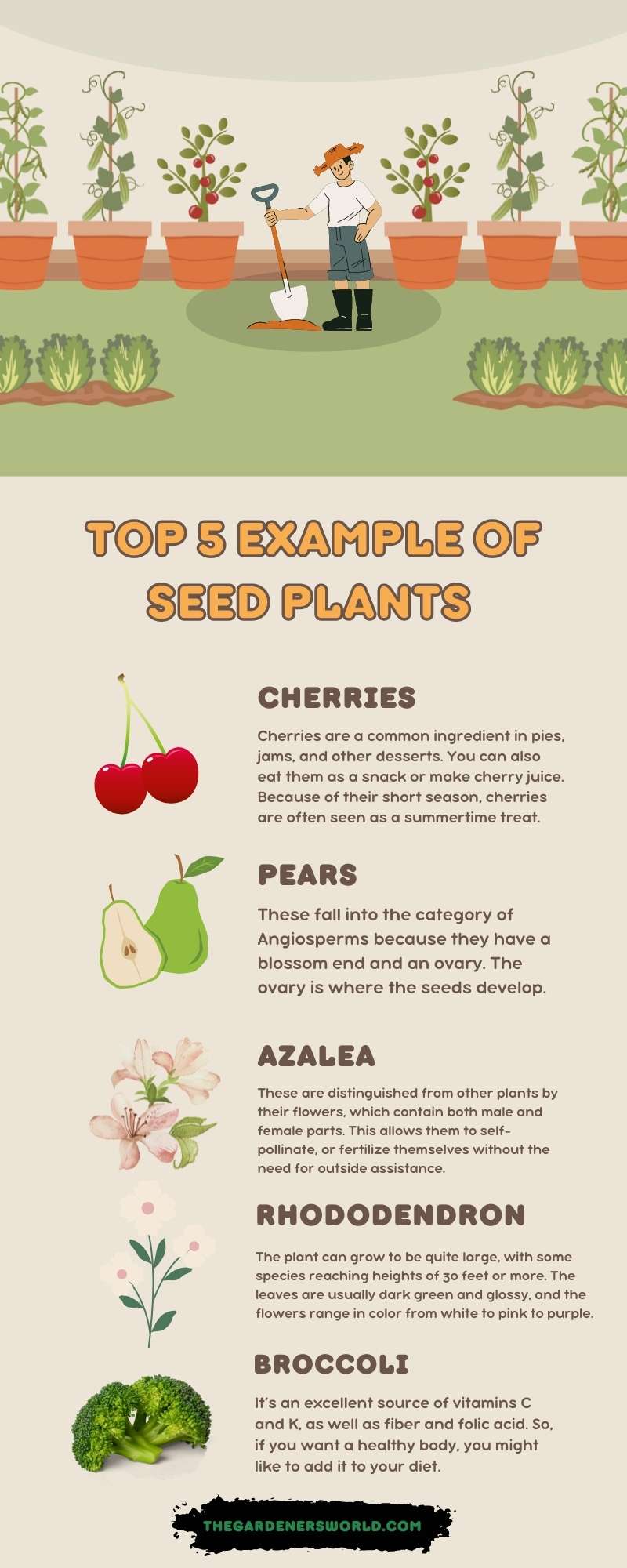
    An infographic of Top 5 Example of Seed Plants

    Types of Seed Plants

    There are two main types of seed plants: angiosperms and gymnosperms. 

    Angiosperms

    Angiosperms plant

    You may know them as flowering plants, and these are most common types of seed plants. 

    The plants produce seeds that are enclosed in a protective layer, such as a flower or fruit. 

    Seed plants are further divided into monocots and dicots based on the number of cotyledons or seed leaves they possess. Monocots typically have one cotyledon, while dicots have two. Within these two groups, there is a great deal of diversity among seed plants.

    Gymnosperms 

    Gymnosperms plant

    Gymnosperms, on the other hand, produce exposed seeds that are not enclosed in a protective layer. 

    In fact, they are distinguished from other plants by their naked seeds. 

    You’ll find these seed plants in all parts of the earth. 

    These plants provide food and shelter for wildlife, and their wood is used for building material and fuel. Some gymnosperms, such as pine trees, are also grown commercially for their timber.

    A Few Examples of Angiosperms

    Cherries

    Cherries plant

    Scientific Name: Prunus Avium

    Classifications:

    Kingdom:    Plantae

    Order:    Rosales

    Family:    Rosaceae

    Subfamily:    Amygdaloideae

    Tribe:    Amygdaleae

    Genus:    Prunus L.

    It belongs to the Angiosperm family. This family includes all flowering plants, which is why cherries have a beautiful bloom around their stem. 

    These are delicate fruit and must be harvested by hand in order to avoid bruising. You’ll see them red or dark purple in color when ripe and have a juicy, sweet flesh. 

    Cherries are a common ingredient in pies, jams, and other desserts. You can also eat them as a snack or make cherry juice. Because of their short season, cherries are often seen as a summertime treat.

    Keep in mind that cherries are just one example of the amazing diversity found within the Angiosperm family. This family includes everything from delicate flowers to towering trees. Thanks to the hundreds of thousands of different species, Angiosperms truly are the backbone of the plant world.

    Pears 

    Pears plant

    Scientific Name: Pyrus Communis L.

    Classifications:

    Kingdom:    Plantae

    Order:    Rosales

    Family:    Rosaceae

    Subfamily:    Amygdaloideae

    Tribe:    Maleae

    Subtribe:    Malinae

    Genus:    Pyrus L.

    These fall into the category of Angiosperms because they have a blossom end and an ovary. The ovary is where the seeds develop. 

    Pears also have a stem, leaves, and a root system. These are available in many amazing colors, including green, yellow, and red. 

    These fruits are a good source of vitamins C and K. They also contain fiber and antioxidants.

    Azalea

    Azalea plant

    Scientific Name: Rhododendron indicum

    Classifications:

    Kingdom:    Plantae

    Order:    Ericales

    Family:    Ericaceae

    Genus:    Rhododendron

    Subgenus:    Rhododendron subg. Azaleastrum

    Section:    Rhododendron sect. Tsutsusi

    These are distinguished from other plants by their flowers, which contain both male and female parts. This allows them to self-pollinate, or fertilize themselves without the need for outside assistance. 

    These also have seeds that are encased in a hard shell. This helps to protect the seeds from being eaten by animals. 

    They are prized for their beautiful flowers. They usually bloom in the spring, and their blossoms come in several gorgeous colors. 

    Rhododendron

    Rhododendron plant

    Scientific Name: Rhododendron ferrugineum

    Classifications:

    Kingdom:    Plantae

    Order:    Ericales

    Family:    Ericaceae

    Subfamily:    Ericoideae

    Tribe:    Rhodoreae

    Genus:    Rhododendron L.

    You’ll find them in the mountainous regions of Asian countries such as Nepal, Tibet, and India. 

    It’s a member of the Ericaceae family, which also includes azaleas, blueberries, and cranberries. 

    The plant can grow to be quite large, with some species reaching heights of 30 feet or more. The leaves are usually dark green and glossy, and the flowers range in color from white to pink to purple. 

    Rhododendrons prefer cool temperatures and shady conditions, so they are not well suited for hot climates. They also need acidic soil in order to flourish.

    Broccoli

    Broccoli plant

    Scientific Name: Brassica oleracea

    Classifications:

    Kingdom:    Plantae

    Order:    Brassicales

    Family:    Brassicaceae

    Genus:    Brassica

    Species:    B. oleracea

    It’s one of those vegetables that you either love or hate. Some people find its slightly bitter taste to be off-putting, while others enjoy its crunchy texture and appreciate the health benefits that it provides. 

    It’s an excellent source of vitamins C and K, as well as fiber and folic acid. So, if you want a healthy body, you might like to add it to your diet. 

    Furthermore, it also contains compounds that have been shown to boost the immune system. 

    Though you can consume it raw, many prefer to cook it in order to soften the texture and reduce the bitterness. Steaming is a popular method, but broccoli can also be roasted, grilled, or stir-fried.

    A Few Examples of Gymnosperms 

    Pine Trees

    Pine Trees plant

    Classifications:

    Kingdom:    Plantae

    Division:    Pinophyta

    Class:    Pinopsida

    Order:    Pinales

    Family:    Pinaceae

    Subfamily:    Pinoideae

    Genus:    Pinus L.

    Unlike angiosperms, gymnosperms don’t produce fruits or flowers at all. Instead, their seeds are exposed, making them vulnerable to drying out. 

    However, for this reason, gymnosperms can reproduce in cold environments where angiosperms would struggle to survive. 

    Pine trees are a common type of gymnosperm, and they play an important role in the environment. These trees help to stabilise the soil and provide shelter for other plants and animals. In addition, their needles make the perfect home for caterpillars, which are an important food source for birds.

    You can identify pine trees by looking at their darker and of muted leaves.

    Cypress

    Cypress plant

    Scientific Name: Cupressus sempervirens

    Classifications:

    Kingdom:    Plantae

    Division:    Pinophyta

    Class:    Pinopsida

    Order:    Pinales

    Family:    Cupressaceae

    Subfamily:    Cupressoideae

    Genus:    Cupressus L.

    These trees are special because of how adaptable they are- they can grow in water, on hillsides, and in swamps. 

    They’re also one of the longest-living tree species around. The wood is rot-resistant and was used by ancient cultures to build boats and houses. 

    And even today, it’s still used by people for construction and furniture-making.

    Hemlock

    Hemlock plant

    Scientific Name: Conium maculatum

    Classifications:

    Kingdom:    Plantae

    Order:    Apiales

    Family:    Apiaceae

    Genus:    Conium

    Species:    C. maculatum

    It’s one of those very beautiful trees that you must have in your property. The tree has a dense, conical crown of dark green needles. 

    It also offers itself as an essential medium of food and shelter for many animals, including squirrels, birds, and deer. 

    However, you may know it for its poisonous properties. All parts of the tree contain a substance called coniine, which can cause paralysis and death if ingested in large quantities. 

    For this reason, it is important to be cautious when handling hemlock or any products made from it. 

    Yew Tree

    Yew Tree plant

    Scientific Name: Taxus baccata

    Classifications:

    Kingdom:    Plantae

    Division:    Pinophyta

    Class:    Pinopsida

    Order:    Pinales

    Family:    Taxaceae

    Genus:    Taxus

    Species:    T. baccata

    An interesting thing about the yew tree is that it has a thick trunk with red-brown bark and small, dark green leaves. 

    However, you may need to be careful of the fruit of the tree. It gives birth to small, round berries that are harmful to humans but attractive to birds. 

    Regarding the wood, it’s dark red and very dense. 

    For centuries, our ancestors have been using tree for making beautiful furniture and archery bows.

  • A Comprehensive List of Monocot Plants for Tree Lovers (With Pictures)

    A Comprehensive List of Monocot Plants for Tree Lovers (With Pictures)

    It turns out that plants can be pretty lazy. Well, at least some of them can. There are a ton of monocot plants out there that only have one cotyledon or embryonic leaf. 

    Jokes aside, while this may seem like a disadvantage to some plants, it actually has many benefits. 

    Check out some examples of monocot plants and see for yourself!

    What’s The Definition Of Monocot Plants And Its Role In the Ecosystem?

    What's The Definition Of Monocot Plants And Its Role In the Ecosystem

    A monocot plant is a plant that has just one seed leaf when it germinates (sprouts). They have shallow root systems and long, slender leaves. You’ll see them bloom in mid-spring, and their flowers often have three petals.

    These plants make up about a quarter of all plant species, and they are found in every region of the earth. Many common crops, such as wheat, rice, and corn, are monocots. 

    One of the most notable examples of a monocot is grass. Though often dismissed as little more than weeds, grasses are actually a vital part of many ecosystems. 

    They help to stabilize soil, prevent erosion, and provide food and shelter for a variety of animals. In addition, they play an important role in carbon sequestration. This helps us to mitigate the effects of climate change.

    The plants aren’t ideal for use as lumber. But they require less water and can grow in drier climates than other plants. 

    Overall, with their distinctive features and wide range of habitats, monocot plants are an intriguing and important group of plants.

    An Infographic of Top 5 Example of  Monocot Plants

    Monocot Plants Examples

    1. Turmeric

    Turmeric plant

    Scientific Name: Curcuma longa

    Classifications:

    Kingdom:    Plantae

    Order:    Zingiberales

    Family:    Zingiberaceae

    Genus:    Curcuma

    Species:    C. longa

    Turmeric (Curcuma longa) is a versatile plant in the ginger family. Not only is it used as a spice in many cuisines, but it also has a long history of use in medicine. 

    Turmeric is classified as a monocot plant because it has a single cotyledon (seed leaf) in its seed. This group also includes plants such as rice, wheat, and corn. 

    Monocots are recognized for having linear leaves with parallel veins and taproots. 

    It’s grown in India and Southeast Asia and has been cultivated for centuries. The plant thrives in warm, humid climates and requires little care to thrive. 

    Turmeric plants grow to about three feet tall. The aromatic roots are the part of the plant that is most commonly used in cooking and medicine. 

    When dried and ground, the roots have a warm, earthy flavor that complements many dishes. Curcumin, the active ingredient in turmeric, is the reason for the plant’s signature yellow color. 

    This compound has potent antioxidant and anti-inflammatory properties. This explains why turmeric has long been used as a natural remedy for various ailments. While more research

    2. Agapanthus

    Agapanthus plant

    Scientific Name: Agapanthus praecox

    Classifications:

    Kingdom:    Plantae

    Order:    Asparagales

    Family:    Amaryllidaceae

    Subfamily:    Agapanthoideae

    Genus:    Agapanthus

    Agapanthus is a monocot plant. So, naturally they share certain traits with other monocot plants like turmeric, lilies, and the Azucena flower. For instance, these plants have narrower leaves and stems than dicots. Moreover, they grow in a more upright fashion, with their leaves and flowers clustered at the top of the stem.

    Also known as African lily or Lily of the Nile, agapanthus grows in South Africa and thrives in hot, dry conditions. 

    It’s available in many colors, including blue, purple, white, and pink. Agapanthus is resistant to drought and can even survive in poor-quality soil. It’s also resistant to pests and diseases, making it a low-maintenance option for busy gardeners.

    3. Banana

    Banana Plants

    Classifications:

    Kingdom:    Plantae

    Order:    Zingiberales

    Family:    Musaceae

    Genus:    Musa

    Banana plants are monocots because they have only one cotyledon in their seeds. One of the most distinguishing characteristics of monocots is their vascular tissue arrangement. 

    In the banana plant, like other monocots, the vascular bundles (the parts of the plant that conduct water and minerals) are scattered throughout the stem rather than being grouped together in a ring as they are in dicots.

    You can attribute the light, spongy texture of bananas to this random arrangement.

    4. Rice

    Rice plants

    Scientific Name: Oryza Sativa

    Classifications:

    Kingdom:    Plantae

    Order:    Poales

    Family:    Poaceae

    Genus:    Oryza

    Species:    O. sativa

    As one of the monocots, rice is one of the most popular grains in the world. As per the written history, it was first grown in China over 10,000 years ago, and it quickly spread to other parts of Asia. 

    Nowadays, rice is a staple food in many countries, and it is used in a huge variety of dishes. 

    You may connect it with Asian cuisine mainly; it can be used in all sorts of recipes, from Italian risotto to Spanish paella to Indian curries. 

    5. Bamboo

    Bamboo plants

    Classifications:

    Kingdom:    Plantae

    Order:    Poales

    Family:    Poaceae

    Clade:    BOP clade

    Subfamily:    Bambusoideae

    Bamboo is a fast-growing rhizome plant, and you’ll be surprised to know that some species can grow up to four feet in a day. 

    The tallest recorded bamboo plant was over 100 feet tall. 

    Though bamboo is commonly found in Asia, it can be grown in many regions of the world, including Africa, Australia, and the Americas. 

    It’s a very useful plant that can be used for everything from building materials to food. It is also one of the most sustainable resources on Earth. Furthermore, it is also very strong – some types of bamboo have been known to withstand hurricane-force winds.

    6. Asparagus 

    Asparagus plant

    Scientific Name: Asparagus officinalis

    Classifications:

    Kingdom:    Plantae

    Order:    Asparagales

    Family:    Asparagaceae

    Subfamily:    Asparagoideae

    Genus:    Asparagus

    Species:    A. officinalis

    This monocot plant is also a perennial plant, meaning it can live for more than two years. It takes three years for an asparagus plant to mature enough to produce spears, but once it does, it will continue to produce for 15-20 years.

    The flowers are white or pale green, with six petals; they are borne in clusters on erect stems 10–30 cm (4–12 in) long at the apex of the plant.

    7. Daffodils

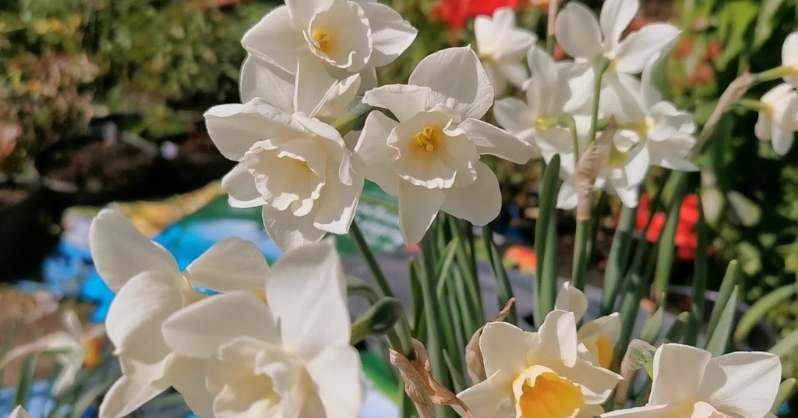
    Daffodils plants

    Scientific Name: Narcissus Poeticus

    Classifications:

    Kingdom:    Plantae

    Order:    Asparagales

    Family:    Amaryllidaceae

    Subfamily:    Amaryllidoideae

    Tribe:    Narcisseae

    Genus:    Narcissus L.

    Did you know that daffodils are a type of monocot? Yes, they are and have narrow, strap-like leaves and a single seed leaf. 

    Daffodils are in the genus Narcissus, which contains around 50 different species. The most common type of daffodil is the trumpet daffodil, which has a long, curved trumpet-shaped bloom. In the United States, daffodils are often planted in public parks and gardens for beautification. 

    After the blooms have faded, the plant will produce a long, green stalk that is topped with a small, round seed pod. Once the seed pod has ripened, it will burst open, releasing seeds that can be planted to grow new daffodils.

    How Will You Identify Monocot Plants

    Identify Monocot Plants

    There are some unique characteristics with which you can easily recognize monocot plants. Here are they:

    • Have a single cotyledon in their seedlings
    • Leaves are usually parallel-veined
    • Flower in groups of three
    • Almost always lack secondary growth
    • Stems of most monocots are round in cross-section
    • Many monocots are grasses
  • A Beginner’s Guide to Bulb Plants: Tips & Examples

    A Beginner’s Guide to Bulb Plants: Tips & Examples

    What comes to mind when you think of bulb plants? Tulips and daffodils probably spring to mind, but there are many other amazing bulb plants out there.

    In fact, you might be surprised by how many different kinds there are. 

    So, without further ado, let’s take a look at some bulb plants examples.

    What You Need to Know About Bulb Plants

    You see, these plants are just like any other type of plant, except they have a bulb instead of roots. A bulb is an underground structure surrounded by fleshy scales that contain the embryo of the future plant.

    The bulb stores water and nutrients, which the plant uses to grow. Also, the majority of bulb plants are perennials, meaning they live for more than two years. 

    That’s pretty much the opposite of annuals which only live for one year, and biennials which take two years to complete their lifecycle.

    What’s the Reproduction Process for Bulb Plants?

    Bulb plants are easy to propagate, and there are a few different methods you can use. 

    One way is to simply dig up the bulbs in late summer or early fall and replant them elsewhere. 

    You can also divide the bulbs, which is especially useful if they’ve become overcrowded. 

    To do this, gently dig up the clump of bulbs and carefully separate them into individual bulbs. Plant the bulbs immediately, making sure that each one has enough space to grow. 

    Also, you can also propagate bulb plants from seed. This takes a bit longer, but it’s a great way to produce new plants for your garden. 

    Start by planting the seeds in pots or trays filled with seed-starting mix. Keep the soil moist and warm, and wait for the seeds to germinate. 

    Once the seedlings have sprouted, transplant them into your garden bed. With a little patience, you’ll soon have a beautiful garden full of healthy bulb plants.

    An Infographic of Top 5 Examples of Bulb Plants Can Grow in Your Garden

    Examples of Bulb Plants

    Onion 

    Onion plants

    Scientific Name: Allium cepa

    Classifications: 

    Kingdom:    Plantae

    Order:    Asparagales

    Family:    Amaryllidaceae

    Subfamily:    Allioideae

    Genus:    Allium

    Species:    A. cepa

    Is onion a bulb? Yes, they are. You might think of onions as vegetables, but they are actually classified as bulb plants. That’s why they are related to garlic, leeks, and shallots. 

    Onion bulbs are made up of layered sheaths, and they grow underground. 

    When a farmer pulls the onion from the ground, the outermost layer is usually dry and papery. 

    Underneath this layer, you’ll find the edible part of the onion, which is comprised of multiple layers of thin, fleshy skin. 

    Each layer of onion has a different flavor profile, ranging from sweet to sharp. 

    When you chop the onions with the knife, the different layers mix together to create a distinctive taste. 

    You can use them for cooking, as their strong flavor can add depth and richness to a dish. 

    You can use them either raw or cooked, and they can be used in a variety of recipes. Whether you’re adding diced onions to a soup or slicing them thinly for a salad, there’s no doubt that onions are a versatile ingredient.

    Muscari

    Muscari plant

    Scientific Name: M. neglectum

    Classifications: 

    Kingdom:    Plantae

    Order:    Asparagales

    Family:    Asparagaceae

    Subfamily:    Scilloideae

    Genus:    Muscari

    One of the most common questions I get as a gardener is what type of bulb plant is best for naturalizing. My answer is always Muscari. 

    Also known as grape hyacinths, these plants are incredibly easy to maintain. These flowers come on their own in spring and produces beautiful blue flowers. 

    You’ll love how quickly they can spread. So you will enjoy an abundance of color without having to put in a lot of work. 

    If you prefer a low-maintenance bulb plant that will add a splash of color to your garden, Muscari would be a great option.

    Amaryllis

    Amaryllis plant

    Scientific Name: Amaryllis belladonna

    Classifications: 

    Kingdom:    Plantae

    Order:    Asparagales

    Family:    Amaryllidaceae

    Subfamily:    Amaryllidoideae

    Tribe:    Amaryllideae

    Genus:    Amaryllis L.

    It’s an aesthetic bulb plant that originates from the Western Cape of South Africa. It is a member of the Amaryllidaceae family. 

    The amaryllis is a lovely plant to grow indoors, as it won’t take much effort on your end to take care of it. The plant typically blooms in late winter or early spring, and it produces large, showy flowers. 

    These bulb plants are available for purchase from many garden stores and online retailers. If you are thinking about growing an amaryllis, there are a few things you should keep in mind. 

    Always make sure to plant the bulb in well-drained soil. 

    And, water the plant regularly, but be careful not to overwater it. 

    Moreover, give the plant plenty of light; amaryllis plants need at least six hours of sunlight per day. 

    Jonquil

    Jonquil plants

    Scientific Name: Narcissus jonquilla

    Classifications: 

    Kingdom:    Plantae

    Order:    Asparagales

    Family:    Amaryllidaceae

    Subfamily:    Amaryllidoideae

    Genus:    Narcissus

    Species:    N. jonquilla

    The jonquil is a spring-flowering bulb. 

    You’ll find that Jonquils have a strong, sweet fragrance. 

    They come in a variety of colors, including yellow, orange, and white. The jonquil comes from southern Europe and northern Africa. 

    It came to the United States in the early 1800s. 

    In present times, it is widely grown as a garden plant. Plants will bloom about six weeks after planting. Once they have finished blooming, let the foliage die back naturally. 

    Jonquils will bloom best if you do not bother them for several years. After that, you can dug them up, divide them, and replant them every three to four years.

    Tulip

    Tulip plants

    Scientific Name: Tulipa Gesneriana

    Classifications: 

    Kingdom:    Plantae

    Order:    Liliales

    Family:    Liliaceae

    Subfamily:    Lilioideae

    Tribe:    Lilieae

    Genus:    Tulipa L

    When one says Tulip, Holland immediately comes to the mind. Now, though they’re often associated with Holland, tulips actually originated in the Middle East and Central Asia. 

    They were first brought to Europe in the 16th century, and they quickly became a symbol of wealth and luxury. 

    Today, tulips are still highly prized for their beauty, and they’re the first choice for both gardens and cut flowers. 

    Though they’re often seen as delicate blossoms, tulips are actually quite hardy—they’re even able to withstand frost and snow. 

    This resilience is due in part to their bulbous form. Tulip bulbs are thick, fleshy structures that store nutrients and water, allowing the plant to survive long periods of dormancy. 

    When conditions are right for growth, the bulb will produce a shoot that grows into a stem. Eventually, this stem will produce a beautiful flower. 

    Daffodil

    Daffodil plants

    Scientific Name: Narcissus Poeticus

    Classifications: 

    Kingdom:    Plantae

    Order:    Asparagales

    Family:    Amaryllidaceae

    Subfamily:    Amaryllidoideae

    Tribe:    Narcisseae

    Genus:    Narcissus L.

    It’s a type of bulb plant that is often associated with springtime. They are known for their bright yellow flowers and green leaves, which make them an automatic choice for gardens and floral arrangements. 

    While you may consider daffodils as a spring flower, they can actually bloom in any season, depending on the type. 

    For instance, some varieties of daffodil will bloom in the summer or fall. 

    Despite famous for their beauty, the monocot plant is not difficult to maintain.

    Lilium

    Lilium plant

    Scientific Name: Lilium candidum

    Classifications: 

    Kingdom:    Plantae

    Order:    Liliales

    Family:    Liliaceae

    Subfamily:    Lilioideae

    Tribe:    Lilieae

    Genus:    Lilium L.

    Bulb plants are a great way to add color and interest to your garden, and lilies are a classic choice. 

    Well-loved by gardeners for simple maintenance, lilies come in a large number of colors and cultivars, making them ideal for any garden. 

    Plant bulbs in the fall, and they will bloom the following spring. 

    Remember that these flowers love full sun and sapped soil, and they will thrive with regular watering. 

    When the blooms fade, allow the plant to die back naturally. This will help to replenish the bulb, ensuring that it will bloom again next year. 

    Let’s Discuss the Types Of Bulb Plants

    Types Of Bulb Plants

    There are many different types of bulb plants, and each has its own unique blooms. Let’s learn about them here:

    Tunicate bulbs

    They have an outer protective scale or tunic and a basal plate from which the root system emerges. 

    The bulbs of many species also have contractile roots that help to anchor the bulb in the ground. 

    Imbricate bulbs

    They have a series of overlapping fleshy scales, with the youngest scale at the center of the bulb. As the bulb grows, older scales are pushed outwards by newer ones. 

    They lack a tunic or protective outer layer, and their scales are not fused together. The bulb of the amaryllis is an example of a naked bulb. 

    Is It Possible to Identify Bulb Plants By Their Leaves?

    When it comes to identifying bulb plants, leaves can be a helpful clue. To be honest, by taking a close look at the leaves, you can often get a good sense of which type of bulb plant you’re dealing with. 

    Many bulb plants, such as daffodils and tulips, have broad, strap-like leaves that emerge from the ground before the flowers. 

    These leaves are, most of the time, green and may have white stripes or markings. 

    Moreover, other common bulb plants, such as lilies and hyacinths, have more linear leaves that grow directly out of the bulbs. These leaves are often thinner than strap-like leaves and may be variegated or have other distinctive features.

  • 5 Short Day Plants That You Can Grow in Your Garden

    5 Short Day Plants That You Can Grow in Your Garden

    Short day plants flower when the day length is shorter than a certain critical duration. This typically occurs in late summer or early fall in temperate latitudes. 

    Despite their name, these plants are not limited to any one duration and can flower over a range of durations according to the species and environmental conditions. 

    Some notable short day plants include chrysanthemums, poinsettias, lilies, and snapdragons. While there are many different types of long night plants, they all have one thing in common: they need a specific daylight length to initiate flowering.

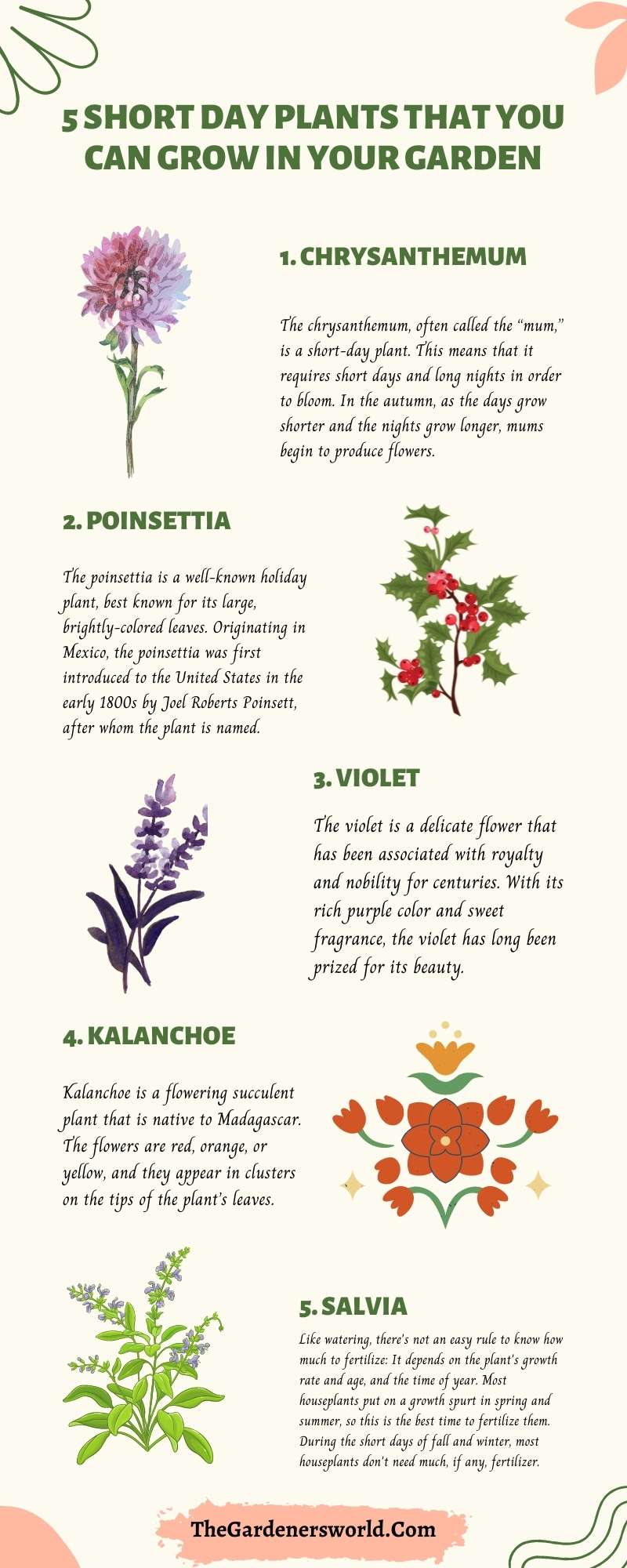
    5 Short Day Plants That You Can Grow in Your Garden

    What Are Short Day Plants?

    What are Short Day Plants

    Short day plants are plants that flower only when the night is longer than the day. This can be due to the plant’s natural inclination or it can be induced by manipulating the length of the night with artificial light. Common short day plants include poinsettias, Christmas cactus, and cyclamen. 

    By manipulating the length of the day, growers can force plants to flower out of season. That applies for both short and long day plants.

    This can be useful for growers who want to have flowers available year-round or who want to produce specific flowers for holidays or other occasions. While short-day plants are commonly grown indoors, they can also be grown outdoors in areas with longer nights.

    Chrysanthemum

    Chrysanthemum Plant

    Scientific Name: Chrysanthemum indicum

    Classifications: 

    Kingdom:    Plantae

    Order:    Asterales

    Family:    Asteraceae

    Subfamily:    Asteroideae

    Tribe:    Anthemideae

    Genus:    Chrysanthemum

    Species:       Chrysanthemum Indicum

    The chrysanthemum, often called the “mum,” is a short-day plant. This means that it requires short days and long nights in order to bloom. In the autumn, as the days grow shorter and the nights grow longer, mums begin to produce flowers. 

    The flowers of the chrysanthemum can be white, yellow, pink, red, or purple, and they are often used in bouquets and arrangements. Chrysanthemums are also a popular choice for adding color to fall gardens. 

    While they are thought of as a fall flower, mums can actually be planted in the spring or summer. They just need to be kept in an area with short days and long nights in order to bloom.

    Poinsettia

    Poinsettia Plant

    Scientific Name: Euphorbia pulcherrima

    Classifications:

    Kingdom:    Plantae

    Order:    Malpighiales

    Family:    Euphorbiaceae

    Genus:    Euphorbia

    Species:    E. pulcherrima

    The poinsettia is a well-known holiday plant, best known for its large, brightly-colored leaves. Originating in Mexico, the poinsettia was first introduced to the United States in the early 1800s by Joel Roberts Poinsett, after whom the plant is named. 

    While the vast majority of poinsettias on the market are red, the plant actually comes in a range of colors, including white, pink, and purple. Regardless of its color, the poinsettia is sure to add a touch of holiday cheer to any home.

    Violet

    Scientific Name: Viola Reichenbachiana

    Classifications: 

    Kingdom:    Plantae

    Order:    Malpighiales

    Family:    Violaceae

    Subfamily:    Violoideae

    Tribe:              Violeae

    Genus:    Viola

    Species:    Viola odorata

    The violet is a delicate flower that has been associated with royalty and nobility for centuries. With its rich purple color and sweet fragrance, the violet has long been prized for its beauty. 

    Today, violets can be found in gardens all over the world. They are relatively easy to grow and make a lovely addition to any landscape. Although they are commonly thought of as being blue, violets actually come in a range of colors, from deep purple to pale lavender. My personal favorite is the rare African violet as their purple shade looks exquisitely beautiful.

    No matter what their shade, violets are sure to add a touch of elegance to any setting.

    Kalanchoe

    Kalanchoe

    Scientific Name: Kalanchoe blossfeldiana

    Classifications: 

    Kingdom:    Plantae

    Order:    Saxifragales

    Family:    Crassulaceae

    Subfamily:    Kalanchoideae

    Genus:    Kalanchoe

    Kalanchoe is a flowering succulent plant that is native to Madagascar. The flowers are red, orange, or yellow, and they appear in clusters on the tips of the plant’s leaves. 

    It is a popular houseplant, and it is also used in folk medicine. The plant has traditionally been used to treat wounds and bruises, and it is also believed to have anti-inflammatory properties. 

    Today, kalanchoe is still used in traditional medicine, and it is also being studied for its potential role in cancer treatment. In addition to its medical uses, kalanchoe is also grown as an ornamental plant. 

    It is low-maintenance, making it an ideal choice for those who want to add a bit of color to their home without having to put in too much work. 

    Salvia

    Salvia Plant

    Scientific Name: Salvia officinalis

    Classifications: 

    Kingdom:    Plantae

    Order:    Lamiales

    Family:    Lamiaceae

    Subfamily:    Nepetoideae

    Tribe:    Mentheae

    Genus:    Salvia

    Species:   Salvia officinalis

    It is also known as sage, and it has a long history of being used for culinary and medicinal purposes. The leaves of the salvia plant are used to flavor food, and they can also be made into tea. 

    Salvia has a number of health benefits, including the ability to improve digestion, relieve stress, and boost cognitive function.

    Green onions

    Green onions plant

    Scientific Name: Allium sativum

    Classifications: 

    Kingdom:    Plantae

    Order:    Asparagales

    Family:    Amaryllidaceae

    Subfamily:    Allioideae

    Tribe:              Allieae

    Genus:    Allium

    Green onions, also known as scallions or spring onions, are a type of onion that is harvested while the bulb is still small. The entire onion, including the green tops, is edible and can be used in a variety of dishes. 

    Green onions have a milder flavor than mature onions, and their delicate texture makes them a perfect addition to salads and stir-fries. When shopping for green onions, look for bulbs that are firm and free of brown spots. The tops should be bright green and perky.

    Soybean

    Soybean Plant

    Scientific Name: Glycine max

    Classifications: dit

    Kingdom:    Plantae

    Order:    Fabales

    Family:    Fabaceae

    Subfamily:    Faboideae

    Genus:    Glycine

    Species:    G. max

    In order to flower, a soybean plant needs to receive at least 12 hours of daylight. However, it can also flower when it receives less than 12 hours of daylight if the temperature is warm enough. Once the plant flowers, it will produce pods that contain soybeans. 

    These beans can be used to make a variety of food products, including tofu and soy milk. Soybeans are a type of legume, which means that they are able to fix nitrogen in the soil.

  • 7 Common C3 Plants That Are Drought-Resistant

    7 Common C3 Plants That Are Drought-Resistant

    I love plants. I really do. Even if I can’t keep a cactus alive for more than two months, I still appreciate their presence in the world. And today, I’ll tell you about one of my favorite types of plants; C3. 

    In the botanical world, c3 plants are extremely admired. Unlike their c4 counterparts, these guys can handle shady environments and cooler temperatures, making them perfect for greener yards and landscaping.

    What Are C3 Plants?

    What Are C3 Plants

    C3 plants are those that use the Calvin Cycle to fix carbon during photosynthesis. The term “C3” comes from the fact that the first stable product of carbon fixation is a three-carbon compound. 

    C3 plants include most of the world’s major food crops, such as wheat, rice, soybeans, and potatoes. They are also found in natural ecosystems, such as temperate forests and grasslands. 

    These plants are well-adapted to cooler climates and tend to be more drought-resistant than C4 plants. 

    However, they are less efficient at photosynthesis and thus require more light to grow. Nevertheless, C3 plants play a vital role in both agriculture and ecosystems worldwide.

    An Infographic on 5 Common C3 Plants That Are Drought-Resistant

    Clover

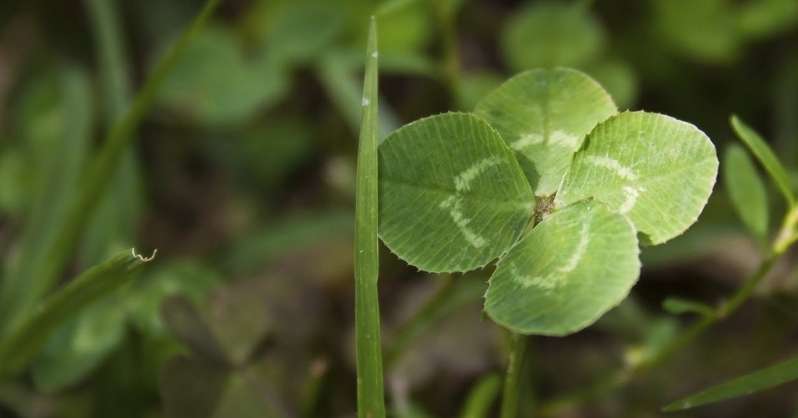
    Clover plant

    Scientific Name: Trifolium repens (white clover)

    Classifications: 

    Kingdom:    Plantae

    Clade:    Tracheophytes

    Order:    Fabales

    Family:    Fabaceae

    Subfamily:    Faboideae

    Tribe:    Trifolieae

    Genus:    Trifolium

    This one is a small, herbaceous plant and is a member of the legume family. And like other legumes, it has nitrogen-fixing bacteria in its roots. 

    This means that it can help to improve soil fertility, making it an ideal crop for farmers who want to reduce their reliance on chemical fertilizers. 

    In addition to its agricultural uses, clover is also a popular food source for bees and other pollinators. The flowers are white or pale pink, and they have sweet nectar that bees find irresistible. Clover honey is prized for its mild flavor, and it is often used in baking and confectionary.

    Barley

    Barley plant

    Scientific Name: Hordeum vulgare

    Classifications:

    Kingdom:    Plantae

    Order:    Poales

    Family:    Poaceae

    Subfamily:    Pooideae

    Genus:    Hordeum

    Species:    H. Vulgare

    Barley is a versatile C3 plant that can be used in a wide variety of dishes. It has a nutty flavor and chewy texture, making it a popular choice for soups, stews, and casseroles. 

    Archaeological evidence suggests that it was first domesticated in the Fertile Crescent, and it quickly spread to other parts of the world. Today, barley is still an important crop, and it is grown in countries all over the world.

    It is also a good source of fiber and protein, making it a nutritious addition to any diet. In addition, it is also sometimes used as livestock feed or as an ingredient in animal bedding. 

    Wheat

    Wheat plant

    Scientific Name: Triticum aestivum

    Classifications: 

    Kingdom:    Plantae

    Clade:    Tracheophytes

    Order:    Poales

    Family:    Poaceae

    Subfamily:    Pooideae

    Supertribe:    Triticodae

    Tribe:    Triticeae

    Genus:    Triticum

    Species:       Triticum aestivum

    wheat is a cereal grain that belongs to the grass family. It is one of the most widely cultivated crops in the world, and it is a major source of food for both humans and livestock. 

    It is a C3 plant, which means that it uses the Calvin cycle to fix carbon dioxide from the atmosphere. The grain of wheat is composed of three parts: the bran, the germ, and the endosperm. 

    The bran is the outermost layer of the grain and contains fiber and nutrients. The germ is the innermost layer, and it contains the wheat’s vitamins, minerals, and oils. 

    The endosperm makes up the largest part of wheat grain, and it contains protein and starch. wheat can be ground into flour to make bread, pasta, pastry, and other baked goods. 

    Spinach

    Spinach plant

    Scientific Name: Spinacia oleracea

    Classifications: 

    Kingdom:    Plantae

    Order:    Caryophyllales

    Family:    Amaranthaceae

    Genus:    Spinacia

    Species:    S. oleracea

    Popeye was onto something when he ate spinach to increase his strength. This leafy green is packed with nutrients that can benefit your health in a variety of ways. For one, this C3 plant is a good source of Iron, which is essential for carrying oxygen through your body. 

    It’s also rich in vitamins A and K, as well as folate, a water-soluble vitamin that helps the body form red blood cells. In addition, spinach contains lutein and zeaxanthin, two antioxidants that can help to protect your eyes from age-related damage. 

    Peanut

    Peanut plant

    Scientific Name: Arachis hypogaea

    Classifications: 

    Kingdom:    Plantae

    Order:    Fabales

    Family:    Fabaceae

    Subfamily:    Faboideae

    Genus:    Arachis

    Species:    A. hypogaea

    Peanut is a type of C3 plant native to South America. They were first brought to the United States by African slaves in the 1600s. 

    Today, peanuts are grown in warm climates all over the world. Peanuts are a popular food because they are relatively inexpensive and they have a high protein content. In addition, they can be used to make peanut butter, which is a favorite food of many people. 

    Cotton

    Cotton plant

    Scientific Name: Gossypium hirsutum

    Classifications:

    Kingdom:    Plantae

    Order:    Malvales

    Family:    Malvaceae

    Genus:    Gossypium

    Species:    G. hirsutum

    This plant belongs to the mallow family. The fibers of the cotton plant are used to make textile products like fabric and thread. The cotton plant is originates from the drylands of Central Asia and is mainly cultivated in tropical and subtropical regions. 

    Cotton is a C3 plant, and due to this difference in photosynthetic pathways, C3 plants are less efficient at fixing carbon dioxide than C4 plants. However, this difference is not large enough to affect agricultural productivity on a global scale. 

    Orchardgrass

    Orchardgrass plant

    Scientific Name: Dactylis glomerata

    Classifications:

    Kingdom:    Plantae

    Order:    Poales

    Family:    Poaceae

    Subfamily:    Pooideae

    Genus:    Dactylis

    Species:    D. glomerata

    Here is a cool-season grass, meaning that it grows best in the spring and fall. It has a deep root system that helps it to withstand drought, and it is also resistant to many types of insects and diseases.

    Orchardgrass is a valuable crop for farmers and ranchers, and it can also be used as a ornamental grass in landscaping.

  • 10 Different Types of CAM Plants ( Example With Pictures)

    10 Different Types of CAM Plants ( Example With Pictures)

    I’m always on the lookout for new plants to add to my garden, and I’ve been interested in exploring the world of CAM plants. 

    But what are CAM plants, exactly? And where can you find them? I did a little research and found some great CAM plants examples that you can grow in your garden.

    Also, I’ll tell you what makes them so special. Stay tuned – we’ll have you ready to ace your next botany quiz in no time!

    What Are Cam Plants?

    CAM plants are a type of plant that utilizes a mechanism called CAM photosynthesis. 

    CAM stands for Crassulacean Acid Metabolism, and it allows the plant to open its stomata at night instead of during the day. This helps the plant to conserve water by reducing evapotranspiration. 

    These plants are found in arid and semi-arid climates, and they make up a significant portion of the world’s desert vegetation. 

    Common CAM plants include cacti and certain types of succulents. While these plants are adapted to dry conditions, they can also be found in wetter habitats such as rainforests. 

    In fact, some CAM plants are epiphytes, which means that they grow on other plants instead of in soil. Epiphytic plants typically have smaller leaves than their terrestrial counterparts. CAM photosynthesis is just one of the many adaptations that allow plants to thrive in different environments.

    An Infographic of Top 5 Popular CAM Plants

    10 Popular CAM Plants That You Should Know About

    Aloe Vera

    Aloe Vera Plants

    Scientific Name: Aloe vera

    Classifications: 

    Kingdom:    Plantae

    Clade:    Tracheophytes

    Clade:    Angiosperms

    Clade:    Monocots

    Order:    Asparagales

    Family:    Asphodelaceae

    Subfamily:    Asphodeloideae

    Genus:    Aloe

    Species:    A. vera

    It’s a CAM plant and employs Crassulacean Acid Metabolism as its major photosynthetic pathway. The gel from the Aloe vera plant can be used to treat burns, wounds, rashes, and insect bites. 

    The gel is also used in cosmetics and as a laxative. The latex from the plant is used as a purgative. Aloe vera is also used in traditional medicine for the treatment of asthma, diabetes, and epilepsy. You’ll need to water this aloe vera plant every 2-3 weeks.

    Cactus

    Cactus plants

    Classifications: 

    Kingdom:    Plantae

    Clade:    Tracheophytes

    Clade:    Angiosperms

    Clade:    Eudicots

    Order:    Caryophyllales

    Family:    Cactaceae

    Cactuses are one of the most distinctive and recognizable types of plant life on the planet. These desert dwellers have adapted to survive in some of the harshest conditions on Earth, and as a result, they have become a staple of both gardens and pop culture. 

    Their spiky forms make them a popular choice for both landscaping and decoration. In addition to their visual appeal, cactuses are also known for their low maintenance requirements. 

    Sedum

    Sedum Plants

    Scientific Name: Sedum acre

    Classifications: 

    Kingdom:    Plantae

    Clade:    Tracheophytes

    Clade:    Angiosperms

    Clade:    Eudicots

    Order:    Saxifragales

    Family:    Crassulaceae

    Subfamily:    Sempervivoideae

    Tribe:    Sedeae

    Genus:    Sedum

    Sedum is a type of CAM plant that have the ability to close its stomata during the day to prevent water loss and then open them at night to take in carbon dioxide. This process allows them to survive in desert conditions where there is little water available. 

    Sedum is also known as stonecrop, and many species are grown as ornamental plants. They need little water, making them ideal for use in rock gardens or xeriscaping. 

    In addition to their water-saving properties, sedum also helps to protect against soil erosion. Their deep roots help to hold the soil in place, and their dense foliage can help to deflect wind and water. 

    Kalanchoe

    Kalanchoe plant

    Scientific Name: Kalanchoe blossfeldiana

    Classifications: 

    Kingdom:    Plantae

    Clade:    Tracheophytes

    Clade:    Angiosperms

    Clade:    Eudicots

    Order:    Saxifragales

    Family:    Crassulaceae

    Subfamily:    Kalanchoideae

    Genus:    Kalanchoe

    Kalanchoe is a genus of succulent plants that includes more than 125 species. The most popular species, Kalanchoe beharensis, is native to Madagascar and is known for its furry leaves. Kalanchoe can thrive indoors or outdoors with minimal maintenance. 

    These plants are known for their bright flowers, which bloom in a wide range of colors, including red, pink, orange, and yellow. Kalanchoe plants prefer sunny locations and well-drained soil, and they should be watered only when the soil is dry to the touch. 

    Snake Plant

    Snake Plant

    Scientific Name: Dracaena trifasciata

    Classifications: 

    Kingdom:    Plantae

    Clade:    Tracheophytes

    Clade:    Angiosperms

    Clade:    Monocots

    Order:    Asparagales

    Family:    Asparagaceae

    Subfamily:    Nolinoideae

    Genus:    Dracaena

    Species:    D. trifasciata

    If you’re looking for a low-maintenance plant that can thrive in just about any condition, the snake plant (or sansevieria) is a great option. Although it’s often seen as a decoration for offices and homes, the snake plant is actually quite rugged and can survive in a wide range of environments. 

    It’s native to Africa, where it grows in sandy or rocky soil. The snake plant is also tolerant of drought and can even thrive in low-light conditions due to being a CAM plant. 

    Pineapple

    Pineapple

    Scientific Name:: Ananas comosus

    Classifications: 

    Kingdom:    Plantae

    Clade:    Tracheophytes

    Clade:    Angiosperms

    Clade:    Monocots

    Clade:    Commelinids

    Order:    Poales

    Family:    Bromeliaceae

    Genus:    Ananas

    Species:    A. comosus

    Pineapple is a classic CAM plant. During the day, pineapple plants close their stomata to stop losing water due to evaporation. Then, at night, they open their stomata to allow carbon dioxide to enter the leaves for photosynthesis. 

    This Crassulacean Acid Metabolism process helps pineapple plants to conserve water, which is especially important in hot, dry climates. In addition to being more drought-tolerant, CAM plants are also better able to tolerate high levels of light and heat. This makes them well-suited to tropical environments like the one where pineapple originates. 

    With its delicious fruit and unique growth pattern, it’s no wonder that pineapple is such a popular plant.

    Opuntia

    Opuntia plant

    Scientific Name: Opuntia littoralis 

    Classifications: 

    Kingdom:    Plantae

    Clade:    Tracheophytes

    Clade:    Angiosperms

    Clade:    Eudicots

    Order:    Caryophyllales

    Family:    Cactaceae

    Subfamily:    Opuntioideae

    Tribe:    Opuntieae

    Genus:    Opuntia

    Opuntia, also known as prickly pear cactus, is a type of cactus that is native to the Americas. The plant has long, flat pads that are covered in sharp spines. The flowers are usually yellow or red, and the fruits are edible and often used in juicing or as an ingredient in a jam. 

    Opuntia grows in a variety of climates, but it is particularly well-suited to desert regions. Opuntia is used for erosion control and as livestock feed.

    Orchids

    Orchids plant

    Classifications: 

    Kingdom:    Plantae

    Clade:    Tracheophytes

    Clade:    Angiosperms

    Clade:    Monocots

    Order:    Asparagales

    Family:    Orchidaceae

    Genus:        Orchis

    Orchids are a fascinating type of CAM plant. They come in a wide variety of shapes, sizes, and colors, and they can be found all over the world. 

    Unlike many other plants, Orchids do not need a lot of care to thrive. They can even grow in places where other plants would not be able to survive, such as in the rainforest canopy or on the side of a cliff. 

    They also have a very long lifespan, and some species can live for over 100 years. In recent years, the popularity of Orchids has exploded, and they are now available everywhere for purchase.

    Jade Plant

    Scientific Name: Crassula ovata

    Classifications: 

    Kingdom:    Plantae

    Clade:    Tracheophytes

    Clade:    Angiosperms

    Clade:    Eudicots

    Order:    Saxifragales

    Family:    Crassulaceae

    Genus:    Crassula

    Species:    C. ovata

    Native to South Africa, the jade plant thrives in warm, dry conditions and can reach up to six feet tall. The CAM plant gets its name from its glossy green leaves, which are smooth and oval-shaped. 

    Jade plants are typically propagated through stem cuttings, and they can live for many years with proper care. Although the jade plant is not known to be poisonous, it can cause stomach upset if ingested in large quantities.

    Calendula

    Calendula plants

    Scientific Name: Calendula officinalis

    Classifications: 

    Kingdom:    Plantae

    Clade:    Tracheophytes

    Clade:    Angiosperms

    Clade:    Eudicots

    Clade:    Asterids

    Order:    Asterales

    Family:    Asteraceae

    Subfamily:    Asteroideae

    Tribe:    Calenduleae

    Genus:    Calendula

    It is a plant in the daisy family that has been used for centuries as a medicinal herb. Commonly known as pot marigold, the calendula flower is native to Asia and Europe and has been introduced to North America, where it is now a common sight in gardens. 

    Calendula has a long history of use in herbal medicine, dating back to at least the 12th century. The Latin name for calendula, Calendula officinalis, means “official” or “of the pharmacists”, indicating its long-standing reputation as a healing herb. 

    In traditional Chinese medicine, calendula is considered a yin tonic herb, which means it is thought to be cooling and helpful for clearing heat from the body. 

    CAM therapies include acupuncture, homeopathy, meditation, and massage therapy, among others. 

  • C4 Plants Examples: The Ultimate Photosynthesizers (With Pictures)

    C4 Plants Examples: The Ultimate Photosynthesizers (With Pictures)

    You probably think of C4 plants as the kind that gives you a wicked sunburn. But there’s more to these plants than just their ability to make you crispy – they’re also some of the most efficient photosynthesizers on Earth! 

    Here, you’ll get to know some of the most well-known c4 plants out there. 

    What Are C4 Plants?

    What Are C4 Plants

    C4 plants are a type of plant that has an adaptation that allows it to better fix carbon dioxide gas. This process is called C4 photosynthesis, and it enables the plant to convert carbon dioxide gas into organic matter more efficiently than other types of plants including C3 plants

    C4 plants are mostly found in tropical and subtropical regions, as they require high temperatures and lots of sunlight to perform C4 photosynthesis effectively. Some of the C4 plants include maize, bermuda grass, and millet. 

    Scientists believe that C4 photosynthesis evolved independently in different plant lineages, as it is a very complex process. 

    However, all C4 plants share a common feature: they all have specialised cells that surround their leaf pores, called bundle sheath cells. These cells help the plant to better capture and use carbon dioxide gas for photosynthesis.

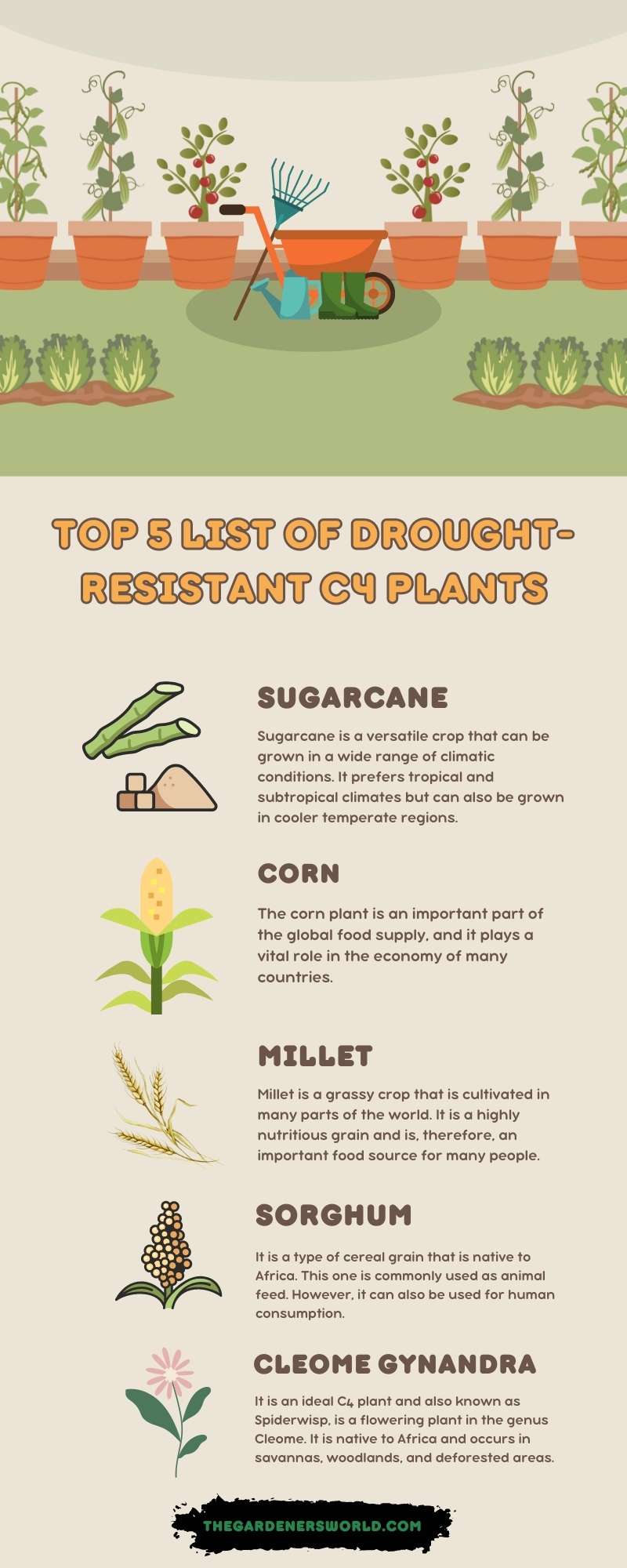
    An infographic of Top 5 List of Drought-Resistant C4 Plants

    A List of Drought-Resistant C4 Plants

    Sugarcane

    Sugarcane plant

    Scientific Name: Saccharum officinarum

    Classifications:

    Kingdom:    Plantae

    Clade:    Monocots

    Order:    Poales

    Family:    Poaceae

    Subfamily:    Panicoideae

    Genus:    Saccharum

    Species:    S. officinarum

    Sugarcane is a tropical plant that is native to the warm, moist climates of South and Southeast Asia. 

    Many might not know that sugarcane is a C4 plant, in fact, it is one of the most important C4 crops in the world.
    Because it is used to produce sugar, molasses, ethanol, and animal feed. 

    Sugarcane is a versatile crop that can be grown in a wide range of climatic conditions. It prefers tropical and subtropical climates but can also be grown in cooler temperate regions. However, it is sensitive to frost and does not tolerate waterlogged soils. 

    Switchgrass

    Switchgrass plant

    Scientific Name: Panicum virgatum

    Classifications:

    Kingdom:    Plantae

    Clade:    Angiosperms

    Order:    Poales

    Family:    Poaceae

    Subfamily:    Panicoideae

    Genus:    Panicum

    Species:    P. virgatum

    Switchgrass is often used as a cover crop or forage crop, and it is also a key component of many prairie ecosystems. 

    It is a hardy C4 plant that can tolerate poor soils and dry conditions and grows in clumps, and can reach up to six feet in height. 

    The leaves of switchgrass are blue-green in color and have a V-shaped tip. The plant flowers from June to August, producing greenish-brown inflorescences. 

    This plant is an important food source for many animals, including deer, rabbits, and birds. It is also used as a biofuel crop due to its high energy content.

    Corn

    Corn Plants

    Scientific Name: Zea mays

    Classifications:

    Kingdom:    Plantae

    Clade:    Monocots

    Order:    Poales

    Family:    Poaceae

    Subfamily:    Panicoideae

    Genus:    Zea

    Species:    Z. mays

    Is there anything more American than a good ear of corn? Sweet, crunchy, and delicious, Maize is a summertime staple. 

    But did you know that corn is actually a type of grass? That’s right – the same stuff that you mow your lawn with is related to those tasty yellow kernels. Corn was first domesticated by Native Americans over 7,000 years ago, and it has been an important part of the American diet ever since.

    The corn plant is an important part of the global food supply, and it plays a vital role in the economy of many countries.

    Millet

    Millet plants

    Scientific Name: Cenchrus americanus

    Classifications:

    Kingdom:    Plantae

    Order:    Poales

    Family:    Poaceae

    Subfamily:    Panicoideae

    Genus:    Cenchrus

    Species:    C. americanus

    Millet is a grassy crop that is cultivated in many parts of the world. It is a highly nutritious grain and is, therefore, an important food source for many people. 

    It is also used as animal feed and can be used to make alcohol or biofuel. The plant itself is relatively drought-resistant and can therefore be grown in arid conditions. 

    Millet is also known to contain high levels of fiber, iron, and magnesium. Consequently, it offers a range of health benefits, including improved digestion and lowered blood pressure.

    Bermuda Grass

    Bermuda Grass

    Scientific Name: Cynodon dactylon

    Classifications:

    Kingdom:    Plantae

    Clade:    Commelinids

    Order:    Poales

    Family:    Poaceae

    Genus:    Cynodon

    Species:    C. dactylon

    It is a type of warm-season turfgrass that is commonly used on golf courses, sports fields, and lawns. 

    Bermuda grass is known for its ability to tolerate high temperatures and heavy foot traffic. But it does have some drawbacks. 

    For example, it tends to turn brown in the winter, and it can be difficult to control its growth. In addition, this grass is a common host for chinch bugs, a type of insect that feeds on the grasses’ leaves. As a result, Bermuda grass requires regular maintenance in order to stay healthy and look its best.

    Sorghum

    Sorghum plant

    Classifications

    Kingdom:    Plantae

    Order:    Poales

    Family:    Poaceae

    Subfamily:    Panicoideae

    Supertribe:    Andropogonodae

    Tribe:    Andropogoneae

    Subtribe:    Saccharinae

    Genus:    Sorghum

    Species.       Sorghum bicolor

    It is a type of cereal grain that is native to Africa. This one is commonly used as animal feed. However, it can also be used for human consumption. 

    The grain can be ground into flour, which can be used to make bread, pasta, and other dishes. Sorghum syrup is another popular product made from the grain. 

    This type of syrup is similar to molasses and can be used as a sweetener in baked goods and beverages. 

    The C4 plant is also gaining popularity as a biofuel source. When fermented, sorghum produces ethanol, which can be used as an alternative to gasoline. 

    Cleome Gynandra

    Cleome Gynandra plant

    Scientific Name: Cleome gynandra

    Classifications:

    Kingdom:    Plantae

    Clade:    Tracheophytes

    Clade:    Angiosperms

    Clade:    Eudicots

    Clade:    Rosids

    Order:    Brassicales

    Family:    Cleomaceae

    Genus:    Cleome

    Species:    C. gynandra

    It is an ideal C4 plant and also known as Spiderwisp, is a flowering plant in the genus Cleome. It is native to Africa and occurs in savannas, woodlands, and deforested areas. 

    The plant is an annual or biennial herb growing to 1–2 m tall. The leaves are pinnately compound with 3-7 leaflets, each leaflet 2-4 cm long and 1-2 cm wide. The flowers are borne in terminal panicles or corymbs. The sepals and petals are pink, purple, or white. The fruit is a capsule containing many small black seeds.

  • 10 Long Day Plants That Will Brighten Your Summer (With Pictures)

    10 Long Day Plants That Will Brighten Your Summer (With Pictures)

    When we think of plants, we usually picture them as passive creatures that just sit around all day, soaking up the sun. However, there are actually a number of plants that have evolved to use the sun to their advantage. 

    They use the extra hours of daylight to for performing crucial processes like setting buds or flowering. In contrast, short day plants don’t need as much light to complete their life cycle, and they are more common in regions closer to the poles. 

    So the next time you’re admiring a beautiful flower, remember that it’s all thanks to the plant’s unique circadian rhythm.

    What are Long Day Plants?

    What are Long Day Plants

    As the name suggests, long day plants need a long period of daylight in order to flower. In the northern hemisphere, this means that they require at least 14 hours of sunlight each day. 

    The longest days of the year are in June, so this is when long day plants typically begin to flower. However, if the days are getting shorter (as they do in late summer and early fall), long day plants will not flower. 

    This is because they use the length of the day as a cue to start flowering, and if the days are getting shorter, they will not flower. In that case, you can grow short day plants in your garden.

    Long day plants also known as short-night plants include many common vegetables, such as spinach, potatoes, and dill. So, if you’re hoping to grow any of these vegetables in your garden, make sure that they are getting enough daylight.

    An Infographic of Top 5 Long Day Plants That Will Brighten Your Summer

    Asters

    Asters flower

    Scientific Name: Aster amellus

    Classifications:

    Kingdom:    Plantae

    Order:    Asterales

    Family:    Asteraceae

    Subfamily:    Asteroideae

    Tribe:    Astereae

    Subtribe:    Asterinae

    Genus:    Aster

    Asters are beautiful flowers that come in many colors, including white, pink, purple, and blue. They’re often used in bouquets and floral arrangements, and they’re a popular choice for gardens. Asters grow best in full sun and well-drained soil. 

    They’re relatively low-maintenance and don’t need a lot of water. However, they can be susceptible to pests and diseases, so it’s important to keep an eye on them. 

    Asters are generally hardy plants, but they may not bloom as well in hot climates. If you live in an area with cool winters, you can plant asters in the fall. They’ll bloom in the spring and summer.

    Coneflowers

    Coneflowers

    Scientific Name: Echinacea purpurea ‘Maxima’

    Classifications

    Kingdom:    Plantae

    Order:    Asterales

    Family:    Asteraceae

    Subfamily:    Asteroideae

    Tribe:    Heliantheae

    Genus:    Echinacea

    In general, coneflowers need at least 14 hours of sunlight in order to bloom. However, the amount of sunlight needed can vary depending on the variety of coneflower. 

    For example, some varieties need as little as 12 hours of sunlight, while others may need up to 16 hours. If you’re not sure how much sunlight your coneflowers need, it’s best to err on the side of too much rather than too little.

    California Poppies

    California Poppies

    Scientific Name: Eschscholzia californic

    Classifications: 

    Kingdom:    Plantae

    Order:    Ranunculales

    Family:    Papaveraceae

    Genus:    Eschscholzia

    Species:    E. californica

    The California poppy is a bright and cheerful flower that is native to the state of California. Also known as the golden poppy, this flower blooms in the spring and summer months. 

    The flowers are typically orange or yellow in color, although they can also be pink or white. California poppies are often planted in gardens, and they are also a common sight along roadsides and in open fields. These hardy flowers are relatively easy to care for, and they make a beautiful addition to any landscape.

    It needs 14 to 18 hours of sunlight each day in order to flower. The best time to plant them is in early spring, so they can get a head start on the growing season.

    Lettuce

    Lettuce flower

    Scientific Name: Lactuca sativa

    Kingdom:    Plantae

    Order:    Asterales

    Family:    Asteraceae

    Genus:    Lactuca

    Species:    L. sativa

    Lettuce is one of those plants that you can pretty much grow anywhere. As long as it gets enough sunlight, it’ll be fine. In fact, it’s actually classified as a long day plant. That means that it needs at least 14 hours of sunlight every day in order to produce flowers and seeds. Now, most of us aren’t looking to grow lettuce for its flowers or seeds. 

    We’re growing it for the leaves. And that’s where things get a little tricky. You see, when the days start getting shorter, the lettuce starts to develop a bitterness in its leaves. That’s because it’s preparing to go into flower mode. So, if you want to avoid that bitterness, you need to make sure that your lettuce gets plenty of sunlight.

    The good news is that there are plenty of ways to do that. You can grow it indoors under lights, or you can plant it in a sunny spot in your garden. Just make sure that it gets enough light, and you’ll be able to enjoy crisp, delicious salads all season long.

    Spinach

    Spinach flower

    Scientific Name: Spinacia Oleracea

    Kingdom:    Plantae

    Order:    Caryophyllales

    Family:    Amaranthaceae

    Genus:    Spinacia

    Species:    S. oleracea

    Spinach is typically planted in late spring or early summer, when the days are longest. Because it is a cool-weather crop, spinach also prefers cooler temperatures and will bolt (produce flowers and seeds) if exposed to too much heat. 

    When choosing a spot to plant spinach, look for an area that gets full sun in the morning but is shaded from the hot afternoon sun. This will help to ensure that the leaves stay crisp and cool.

    Dill

    Dill

    Scientific Name: Anethum graveolens

    Classifications: 

    Kingdom:    Plantae

    Order:    Apiales

    Family:    Apiaceae

    Subfamily:    Apioideae

    Tribe:    Apieae

    Genus:    Anethum L.

    Species:    A. graveolens

    Dill is a relatively tolerant plant and can withstand some variation in the length of daylight it receives. For example, dill plants that are exposed to 12 hours of light each day will still produce some flowers, although the overall yield will be lower than if the plant received 14 hours of light.

    Sugar Beet

    Sugar Beet flower plant

    Species: Beta vulgaris

    Subspecies: Beta vulgaris subsp. vulgaris

    Cultivar Group: Altissima Group

    It is well-suited for cultivation in northern climates, where the days are long during the growing season. Sugar beet is also relatively tolerant of cold weather, making it a good crop for farmers in cooler regions. 

    The roots of sugar beet are rich in sucrose, which is why this crop is used to produce refined sugar. In fact, sugar beet accounts for about 50% of the world’s production of sugar. The leaves of sugar beet can also be used as fodder for livestock, and the plants themselves can be used as a biofuel.

    Henbane

    Henbane flower

    Scientific name: Hyoscyamus niger

    Classifications:

    Kingdom:    Plantae

    Order:    Solanales

    Family:    Solanaceae

    Genus:    Hyoscyamus

    Species:    H. niger

    Henbane is also known as Hyoscyamus niger. It’s a member of the nightshade family and is native to Europe and Asia. The plant has large, dark green leaves and small, white or yellow flowers. 

    All parts of the plant are poisonous if ingested, so it’s best to keep it away from pets and children. Henbane has a long history of use in herbalism. It was used to make ointments that were said to cause hallucinations. In ancient Rome, henbane was used as a way to induce sleep. Today, it’s sometimes used in homeopathic remedies for insomnia and anxiety.

    Peas

    Peas flower

    Scientific Name: Pisum sativum

    Classifciations:

    Kingdom:    Plantae

    Order:    Fabales

    Family:    Fabaceae

    Subfamily:    Faboideae

    Genus:    Pisum

    Species:    P. sativum

    Peas are a type of long-day vegetable, meaning that they need a long period of sunlight each day. Peas are usually planted in the spring, as soon as the ground is thawed and the danger of frost has passed. 

    They can be direct-seeded into the garden, or started indoors and then transplanted out. Peas prefer cool weather and will start to produce Flowers when the days get longer and warmer. 

    Peas can be harvested fresh or allowed to dry on the vine for later use. When choosing peas at the grocery store, look for ones that are plump and have smooth, unbroken skins. Avoid peas that are wrinkled or have brown spots. If you are growing your own peas, harvest them when they are still young and tender for the best flavor.

    Radishes

    Radishes flower

    Scientific Name: Raphanus Raphanistrum 

    Classifications:

    Kingdom:    Plantae

    Order:    Brassicales

    Family:    Brassicaceae

    Genus:    Raphanus

    Species:    R. raphanistrum

    Radishes are one of the earliest vegetables that you can plant in the spring, and they’re also a great choice for growing as a long-day plant. Long-day plants need about 14 hours of sunlight each day to thrive, and radishes are particularly well-suited to this since they have a short growing season. 

    In fact, you can expect to see radishes ready to harvest in as little as four weeks after planting. Radishes are a great way to get a quick and early harvest, and they’re also one of the most versatile vegetables. 

    You can eat them raw, roasted, or in salads, and they come in a wide range of colors, shapes, and sizes. So if you’re looking for a vegetable that you can enjoy all spring and summer long, consider planting radishes.