Author: Neil Thompson

  • 3 Things Plants Release in The Air And How They Affect the Environment

    3 Things Plants Release in The Air And How They Affect the Environment

    Just like we need to breathe to survive, plants also need to breathe. But unlike us, they do not have any specialized organ to breathe, so they respire through their stomata and lenticels. 

    Plants also need food to survive, but they cannot eat like us, so they transpire their food through photosynthesis. But What do plants release into the air? Well, during photosynthesis, plants undergo some gaseous exchanges where they release oxygen, carbon-di-oxide, and water vapor.

    We’ll learn more about them below. 

    What Are the 3 things plants release into the air?

    3 things plants release into the air

    In order to breathe, the plants need to collect some energy to sustain themselves. The same goes for the transpiration process. For breathing and sustaining, they release oxygen into the air and collect CO2. For transpiration, they release their body water as water vapor in the air.

    Let’s dig deeper and know how plants release these elements into the air.

    Oxygen

    Oxygen is used as a byproduct of plants during photosynthesis

    Oxygen is used as a byproduct of plants during photosynthesis. Photosynthesis is the process through which plants produce their food. Plants collect energy from sunlight, CO2 from the atmosphere, and water from the land to make sugar molecules. 

    But before intaking the sugar, they need to break it down just like we do to digest the carbohydrates we intake. To break the sugar molecules, plants need oxygen. Plants use the amount of oxygen needed to break down the carbohydrate and release the rest into the environment. 

    Oxygen is considered a byproduct or waste product of the plants. Even when the plants do not get sunlight to produce their food, they can break down the stored sugar molecule using oxygen.

    Plants also release oxygen during the process of respiration. This process occurs in the roots, stems, and leaves of the plants. It is a continuous process like breathing. The plants use their stomata to release oxygen and lenticel to intake the CO2 in the atmosphere, which they again release during photosynthesis.

    CO2

    CO2 Plant

    Although plants intake co2 during the process of respiration, it releases much of it during photosynthesis. Now, you might think that if co2 is needed to produce food during the photosynthesis process, why do they release a significant portion of it back into the atmosphere.

    During the nighttime, plants cannot perform photosynthesis due to the absence of sunlight. But, they need to balance their metabolism, so they need to absorb some amount of oxygen and release co2. This is how plants release co2 into the air.

    The balance for respiration is needed during night time because during photosynthesis significant amount of oxygen is taken, but co2 remains less. 

    During respiration the energy is released to sustain and breathe; co2 is needed which does not seem to work during the night times. That is why co2 is released in a huge amount during nighttime than during the day

    Water Vapor

    plants stop the transpiration in order to stop the water vapour from releasing in the air

    Plants are also required to excrete like any other living organism. The process for plants to excrete is called transpiration. During transpiration, plants release water in the form of vapour. 

    Sometimes, you will see droplets of water dripping from the plants on their own. This is the result of plants releasing water vapor into the air. The process of transpiration cools down the plants when the weather is too hot for them. Unwanted water is released, mainly from the aerial parts of the plants, through transpiration.

    Sometimes due to the weather being dry, the plants undergo dehydration. At this time, the plants stop the transpiration in order to stop the water vapour from releasing in the air.

    How These Releases Affect The Environment

    The release of these three gases affects the environment greatly. Firstly, all living organism survives through breathing through the exchange of gases. We need oxygen to live and breathe, which we get from the plants. Again the co2 we release in the air is needed by the plants to respire and sustain. A chain of dependency is created due to this exchange of gases. Also, a certain portion of heat is released with respiration which helps us animals keep warm and maintain our internal temperature.

    Another way of affecting the environment is the formation of the ozone layer of the earth. The oxygen produced from photosynthesis forms the ozone layer of the earth, which protects us from the harmful UV rays of the sun. The oxygen released from this process also increases the amount of oxygen in the air.

    Whenever plants release water vapour in the air to cool themselves down, they also cool the air in the atmosphere. The water vapor also provides us with cool air during the hot weather. It also balances the humidity of the air and keeps a balanced environment or weather for us to live.

    Should You Get a Plant in Your Bedroom

    Should You Get a Plant in Your Bedroom

    Keeping plants in your bedroom will not only help you purify the air inside your home but also work as a nice decoration for your room. Plants help you breathe properly, protect you from harmful rays of the sunlight and also cool down the air. So, consider keeping plants in your house.

    Some people think that having plants might increase the amount of co2, which can be poisonous to some extent to your house. But this is not true. It is just an old myth which people loved to believe. Having plants around your house would also lift up your mind as you look up to them. You will also get some positive energy through them.

    Conclusion

    Plants are really important for the whole earth and its living beings to sustain. The gases plants release into the environment help maintain an entire ecosystem and helps us living beings live peacefully. 

    Any disruption in how the plants live and sustain themselves can cause disruption to our livelihood and also the environment. Although plants are small organisms to exist, it maintains the whole ecosystem for us. So, a little care in preserving their lives would also mean preserving our lives as well.

  • The Common Structure That Makes Plants and Animals Cells Work

    The Common Structure That Makes Plants and Animals Cells Work

    The cells of animals and plants are both eukaryotic, meaning that they have cells containing a nuclear-bound membrane. And so, both cell types also house organelles which are also membrane-bound, like the mitochondria and the golgi apparatus.

    That said, animal cells and plant cells do not have all of the same organelles, because their cellular needs are different. Think about photosynthesis — a process essential to plants — which requires a chloroplast. But since animals do not photosynthesize, they don’t need chloroplasts.

    So you might then be wondering, which structure is common to plant and animal cells?

    There are quite a few, all described below.

    Cellular Structures Plants and Animals Have in Common

    The following are the organelles and cellular structures that are found in both plant and animal cells.

    Nucleus

    Nucleus

    The nucleus is the most important part of any cell — it is like the cell’s brain. It is responsible for regulating and controlling everything that goes on inside the cell. The nucleus looks after not only the essential functions of metabolism and growth, but it also contains the genes which carry the cell’s hereditary information.

    In plant cells, the nucleus lies to one side. In animal cells, it sits in the very center.

    Vacuole

    Vacuole

    Vacuoles are small organelles which are responsible for activities involving storage and waste, as well as maintaining the cell’s structure and shape.

    While plant cells have one large vacuole, animal cells have several smaller ones.

    Centrioles

    Centrioles regulate and organize the microtubules which together make up the skeletal system of a cell. The centrioles influence where the organelles of a cell will sit, and they are responsible for cell division.

    However, centrioles occur mainly in animals. They occur only in some lower plants. Lower plants are those which are made up of cilia flagella, such as algae and fungi. Within the flagella are the plant cell’s centrioles.

    There are no centrioles in higher plants.

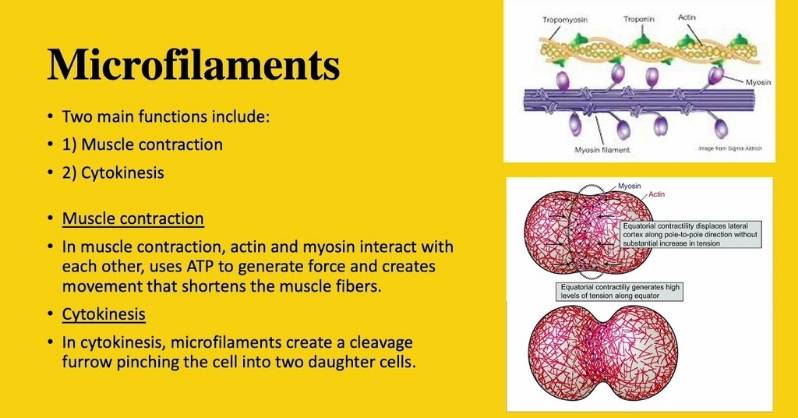
    Microtubules / Microfilaments

    Microtubules / Microfilaments

    The cytoskeleton of a cell is made up of microtubules, microfilaments and intermediate filaments. The microtubule network regulates cell movement and growth and other important activities which balance and maintain processes central to sustaining life. The functions of mitosis, intracellular transport, cell motility and shape can all be attributed to the microtubule network.

    Cytoplasm

    Cytoplasm

    Both animal and plant cells require cytoplasm, which is a thick liquid filling the cell. The cytoplasm is tasked with containing and securing the cell’s components, protecting them from harm. Furthermore, the cytoplasm is where all molecules dedicated to cellular processes live.

    Ribosomes

    Ribosomes

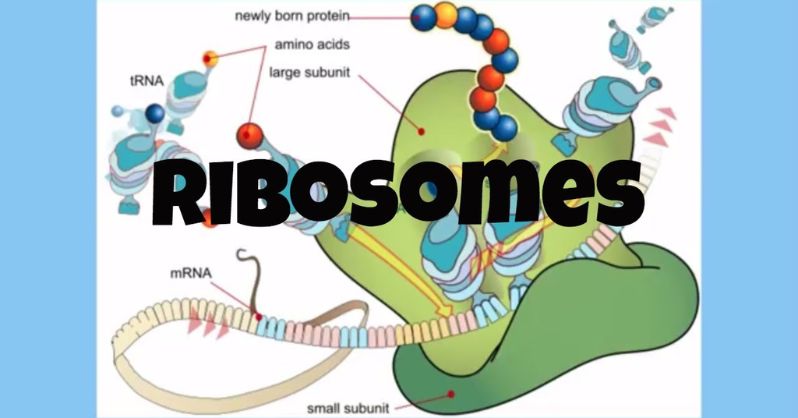
    Ribosomes execute the essential task of protein synthesization, which is a primary function carried out by all living cells. Ribosomes are made of protein and RNA; the former is responsible for converting genetic code into amino acid chains. The genetic codes are the instructions which organelles must follow in carrying out the task of sustaining life — and that’s why ribosomes are present in every living cell.

    Endoplasmic Reticulum (Smooth and Rough)    

    Endoplasmic Reticulum (Smooth and Rough)    

    The endoplasmic reticulum is one of the largest organelles present in both animal and plant cells. They are multifunctional, in that they store calcium, metabolize essential lipids (such as cholesterol) and carbohydrates, and also contribute to protein synthesis.

    There are 2 types of endoplasmic reticulum (ER): rough and smooth.

    Rough ER has ribosomes on its membrane, and is capable of storing and synthesizing proteins and lipids.

    Smooth ER does not have ribosomes attached to it. It is capable of storing and synthesizing proteins, but not lipids.

    Peroxisomes

    Peroxisomes

    Peroxisomes are single membrane-bound organelles which carry digestive enzymes. These enzymes carry out metabolic activity, such as disintegrating toxic components. Peroxisomes also contain oxidative enzymes, which perform metabolic activity.

    Golgi Apparatus

    Golgi Apparatus

    In animal and plant cells, the squiggly-looking Golgi apparatus — also known as the Golgi body — assists in packaging and processing lipid molecules and proteins, especially those which are exported out of the cell. The Golgi body is named after Camillo Golgi, who discovered it.

    Plasma Membrane

    Plasma Membrane

    The cells of plants have both a cell membrane and a cell wall. In contrast, there’s no cell wall in animal cells, but they do have a cell membrane. In plants, the cell membrane is surrounded by the cell wall, and that’s how plant cells get their rectangular shape.

    The plasma membrane is what separates the cell from the environment in which it exists. As such, all cells of all types have a plasma membrane.

    Flagella

    Flagella

    Flagella are tiny, hair-like structures with a whip-like appearance, which help to propel a cell that needs to move. So, cells which are intended to move contain flagella. Think of mammalian sperm cells, which need to reach the egg. These cells are only able to move, spin, race and dive with the assistance of flagella, which propel the cell.

    Flagella is absent in most plant cells as they do not need to move and do not require something to propel them. However, some plant species which do produce flagellated sperm, such as bryophytes and Ginkgo, contain flagella.

    Cilia

    Cilia

    Cilia are similar to flagella, as they are responsible for moving water around relative to the cell in the cilia’s regular movement. The result is the cell being able to move through water or moving water from one place in the cell to another.

    Like flagella, the majority of plants do not have cells containing cilia. Cilia are only found in the cells of lower plants.

    Final Words

    Which is common between plant and animal cells? Quite a few, it would appear — but there are some important distinctions as well. We hope that our detailed exploration of common plant and animal cellular structures will help you to remember all the different parts better.

    Good luck for that exam!

    Related Posts:

    Maintaining a Balance: How Homeostasis In Plants Keep Them Healthy

    The Energy Factory of The Plant Cell: What Does The Mitochondria Do?

    What Organelles Can You Find in Plant Cells?

    What is The Function of Vacuole In a Plant Cell?

    What Do Leaves Do for A Plant? The Unsung Heroes of Plant World

  • A List Of Transgenic Plants | Genetically Modifying Plants Is a Good Thing

    A List Of Transgenic Plants | Genetically Modifying Plants Is a Good Thing

    Transgenic plants might seem like a very confusing and complex topic. However, that is not the case. In this article, we will be trying to explain transgenic plants and look at some transgenic plants examples. After reading this, hopefully, you won’t find it as complex anymore. 

    What Are Transgenic Plants?

    What Are Transgenic Plants

    You may have encountered the term transgenic plants. So what are they? Simply put, the term transgenic refers to artificially induced genetic features. So transgenic plants are genetically modified plants. 

    Transgenic plants are made by humans by splitting and inserting genes from different species of plants. As you might know, genes are responsible for various characteristics in different plants. As a result of this mix and match, it is possible to create and cultivate modified breeds of plants possessing various desired characteristics. 

    Extracting and recombining DNA techniques are employed to make the desired plant. This also filters out undesirable characteristics from the plant. Some popular techniques of gene insertion are briefly listed below:

    Particle Gun Or Gene Gun

    One of the most common ways of inserting genes into plants is by making use of a particle or gene gun. This coats the desired gene using metal and then fires it into the plant at high speeds. 

    Polyethylene Glycol Mediated Transformation

    This is a high-frequency cell targeting method that can cultivate several desired cells at once. It does not require the use of specialized equipment but usually takes longer.

    Electroporation

    This is a technique that uses electric fields to inject DNA molecules into the cell. Electroporation increases the permeability of cell membranes which allows new molecules to be added to the cell.

    History Of Transgenic Plants

    Early research for transgenic plants began in 1947. Armin Braun, a plant pathologist, found a unique discovery of how a bacterium could inject its DNA into a plant. This discovery was the start of the idea of injecting external DNA into plants to alter their characteristics. 

    The first breakthrough was in 1983, when the first transgenic plant was introduced at Washington University. This was a tobacco plant that had resistance to antibiotics. The scientists made use of a plasmid integration system to insert a segment of external DNA into the tobacco plant.

    Research continued, and one of the most important marks in progress for transgenic plants was the development of golden rice in the 1990s. This was a type of rice with high Vitamin A content and could be served to people in areas with a lack of sources of Vitamin A. Golden rice first saw cultivation in the Louisiana State University Agricultural Center in 2004. 

    Why Create Transgenic Plants?

    Up to this point, you might now be aware of what transgenic plants are and their brief history. However, now you might wonder, why even make transgenic plants, and what benefits do they even bring? As it has been said, transgenic plants contain desired genes from other plants. This can allow scientists to introduce new characteristics to plants. 

    Being able to add foreign characteristics to certain plants is beneficial for several reasons. This includes: 

    Higher Yield

    One of the main reasons to create transgenic plants is to increase the yield of said plants. With the increasing population, there is a higher demand for crops. The number of crops produced can be limited by the amount of land, and as such transgenic plants produce higher yields without requiring too much land. Transgenic plants are being seen as a solid option for farmers to keep up with the increasing population. 

    Disease And Pest Resistance

    Many crops and plants are susceptible to diseases that can highly damage them. An important reason for creating transgenic plants is to insert genes that help boost resistance to pests and diseases. This can allow crops to thrive better and not worry about rodents or insects destroying them, which is a massive boon for many farmers who suffer from this problem.

    Increase Resistance To Heat And Cold

    Some areas in the world experience extreme droughts or are so cold that plants have a hard time thriving. The lack of water during droughts allows only the hardiest of plants to thrive. By being able to insert a gene that helps boost resistance against the heat, it is possible to grow and cultivate plants where it wouldn’t be possible otherwise. This can allow for previously unusable areas to now be able to cultivate plants.

    Faster Than Breeding

    While it is possible to make use of cross-breeding to get desired characteristics onto plants. However, this method is incredibly slow, taking years for the characteristics to develop, and the genes that can be distributed are limited. Such issues are not usually present in methods used to make transgenic plants.

    An Infographic of Top 4 Examples Of Transgenic Plants

    Examples Of Transgenic Plants

    We will be looking at four popular transgenic plants. These are soybean, canola, cotton, and maize.

    Soybean

    Soybean plant

    Genetically modified versions of soybean first saw use in 1996 in the USA. Initially, modifications were made to increase yield and allow soybean to be grown more efficiently. This was the first phase of Genetically Modified (GM) foods.

    Later additions worked on adding more healthy components to soybean. This was an attempt to boost the healthy properties of soybean and its nutritional benefits.  Further modifications led to genetically modified soybean that was healthy, could be grown in harsher environments and was cheaper.

    Canola

    Canola plant

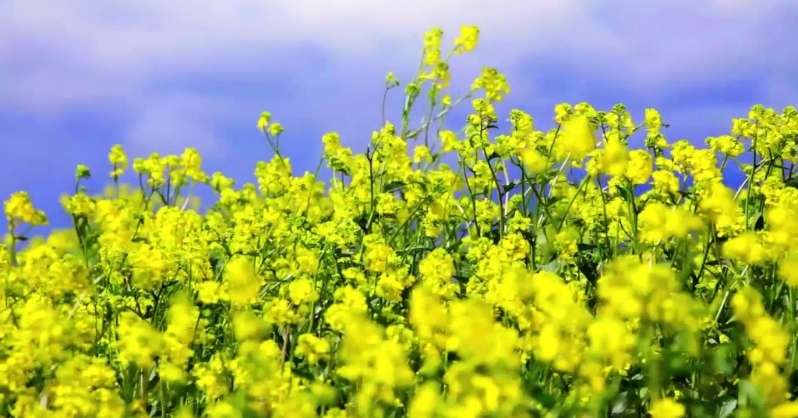
    Canola received genetic modifications and was developed by the Monsanto company. The primary modification of Canola was to make it resistant to the common herbicide known as Glyphosate. It made use of two genes derived from Bacterium to bolster its resistance to the herbicide. 

    Cotton

    Cotton plant

    Genetically modified cotton is one of the most popular transgenic plants commercially. The increase in yield and resistance to pests makes it very useful for many farmers. It’s much easier to grow, thus reducing strenuous labor, and doesn’t get damaged as easily by external factors.

    There are variations of GM cotton that possess different resistances, but the most popular ones for many farmers include pesticide and herbicide-resistant ones. It was initially made using agrobacterium-mediated genetic transformation, but recent variations make use of a pollen tube method instead. 

    Maize

    Maize plant

    Maize as a Monoecious plant would often be susceptible to various pests, including the corn borer that could destroy it. As a result, there was a need to introduce genes that would make the crop pest resistant. Transgenic maize was made by taking a gene from the bacteria bacillus thuringiensis

    By 2011 or so, genetically modified maize saw use in many countries and was also available for import. Development continued to build Maize’s resistance to various external factors, including resistance to drought. 

    The Risks Associated With Transgenic Plants

    While it may seem that everything is great with transgenic plants, they are not without their issues. There can be health issues regarding transgenic plants due to the introduction of unwanted toxic proteins. Consuming these can lead to detrimental effects. 

    Perhaps the biggest risk associated with transgenic plants is unexpected behavior. Some transgenic plants can end up growing too much to the point they become akin to weeds and are often unwanted. However, due to the numerous resistances they have built up, controlling them can be incredibly difficult. There have been cases where genetically modified plants have ended up putting other plants at risk and upsetting the environment. 

    This is a large reason why imports and distribution of said plants are often held off. Due to unexpected changes in the environment that are difficult to predict, they can end up being invasive species and doing more harm than good.

    The Future Of Transgenic Plants

    While there are some risks with transgenic plants, overall, the future remains bright for them due to the possible solutions they can provide for world hunger. Future endeavors will mostly focus on fixing the problems and reducing any risky effects they might have on the environment. The general focus is on making them safer to use and consume.

    Conclusion

    Hopefully, after reading this article, you now have a better idea of what transgenic plants are and why they might be important. With advancements in genetic engineering, the development of transgenic plants has increased by leaps and bounds.  

  • How to Get Rid of Monkshood

    How to Get Rid of Monkshood

    If you’re a Potter-head or a fan of Shakespeare’s poem or if you know about Greek mythology, you would’ve come across the name of Monkshood quite a few times.

    Moreover, people of this state are well aware of this wildflower as they grew up pretty much everywhere. Even some people get anxiety if they hear about Monkshood which is called ‘Aconitum Anxiety’. Scary, isn’t it?

    Well, you don’t need to be scared because we’re here to provide you with how to get rid of Monkshood in an effortless way. Let’s find out the process, shall we?

    Where Does Monkshood Grow?

    Where Does Monkshood Grow

    The common Monkshood flowers grow wildly in Canada, the United States, Europe, and the East side of the Himalayas. Actually, it’ll depend on your location and which type of Monkshood you may find. 

    If you’re in the USA or Canada you’ll get the common blue/purple flowers but if it’s the Himalayas, you may find some unique pieces like greenish Monkshood.

    Why You Should Get Rid of Monkshood?

    Why You Should Get Rid of Monkshood

    You should get rid of Monkshood because of its poison. Well, it’s not some minor poisonous flower; it’s a queen of poisons! They’re also known as Wolfsbane (you may hear this in Harry Potter), devil’s helmet, aconite, and blue rocket.

    The whole flower, especially the roots and leaves, contains poisons known as Aconine and Aconitine. If someone eats it or even touches it, the effects will be shown immediately.

    For the bitter taste of Monkshood, any person won’t grasp it willingly, but if someone does, the throat, tongue, and face will instantly go numb. 

    In addition, that person will feel nauseous, dizzy and his blood pressure will become very low. Again, blurred vision and vomiting symptoms are also included that had been examined by the doctors from the affected person. 

    An affected person can also become paralyzed straight away and get a heart attack that leads him to death.

    How to Get Rid of Monkshood?

    How to Get Rid of Monkshood

    It’s always good to get rid of poisonous wildflowers like Monkshood especially if you have small children or pets in your house. They can touch the flower any time. So it’s better to trim them or cut them off. 

    Here’re some steps you can do it easily.

    • Always wear gloves when you’re touching some wild plants, even if it’s not Monkshood. And for Monkshood, try to wear Red Kap Men’s Long Sleeve Twill Action Back Coverall as the plants are hazardous.
    • As there’re toxins in the flower, make sure to wear 50pcs KN95 Face Mask before you go to your garden or whatever place they’re located.
    • Now, when you’re ready, you can dig them up or pull the plants for the removal process. You can ask for some plant experts who remove wild poisonous flowers, so there’ll be no risk. Also, they’ll confirm you don’t have any leftover flowers or seeds in your garden!
    • You can also put the plants in a compost heap. Just make sure your heap is composting very well. Otherwise, it may create earthworms.
    • Furthermore, try to put a small number of plants in a heap from time to time because too much may not be composted well.

    However, Monkshood is quite tough to grow back once you cut them. So you should make your decision wisely.

    Frequently Asked Questions

    What Will Happen If I Touch Monkshood?

    As you know, Monkshood is a poisonous plant, so if you touch them, the toxins like aconitine, neurotoxins, and mesaconitine will absorb through your skin. It can cause severe cardiac and respiratory problems. Also, know that only a 2mg dose of aconitine can cause your death within 4 hours.

    So, be careful, and if there’s a situation to touch them, make sure you’re wearing Medpride Medical Vinyl Examination Gloves and coveralls.

    Should I Get Rid Of Monkshood?

    Well, if you have children and pets in your home, it’s better not to grow wildflowers like Monkshood. But if you’re a nature person and want to grow this beauty, make sure they’re at a safe place where no children or pets can reach them.

    You can also remove the old blossoms from time to time so that the late season or secondary blossoms can grow up.

    When Should I Cut Monkshood?

    If you want to cut Monkshood, the best time is mid-late summer. Leave them the whole winter, and when they’re visible, you can easily get rid of the pants.

    What colors does Monkshood come in?

    Monkshood or Wolfsbane is usually found blue/purple color when they’re fully grown. The terminal raceme is produced of blue or white, then they modify their color. You can also find this wildflower in a pink or yellowish tone. 

    The interesting thing about them is that their 5 petals look like adapted sepals which can be compared to petaloid!

    Is Wolfsbane and Monkshood the same?

    Yes, they are the same plant. People also know them as aconite, which is known as a dreadful toxin. However, there’re different types of Monkshood that vary in height and color.

    The Bottom Line

    Monkshood may look beautiful and thrilling, but touching a little bit of it or swallowing a small amount can cause your death. This wildflower needs to be taken care of very diligently.

    But now, we’re quite sure that you’ve got the detailed idea about the poisonous portion and learned how to get rid of Monkshood. All you need is some preparation and protection according to the steps mentioned earlier.

    Moreover, make sure to figure out if they’re really a Monkshood plant as there’re 250 types of aconite flowers that go under the aconitum genus. 

    Related Posts:

  • Does Bleach Kill Spiders? 4 Steps To Kill Spiders

    Does Bleach Kill Spiders? 4 Steps To Kill Spiders

    Sometimes spiders can affect your plants and can even kill them. Spiders are very dangerous for indoor plants and your house. 

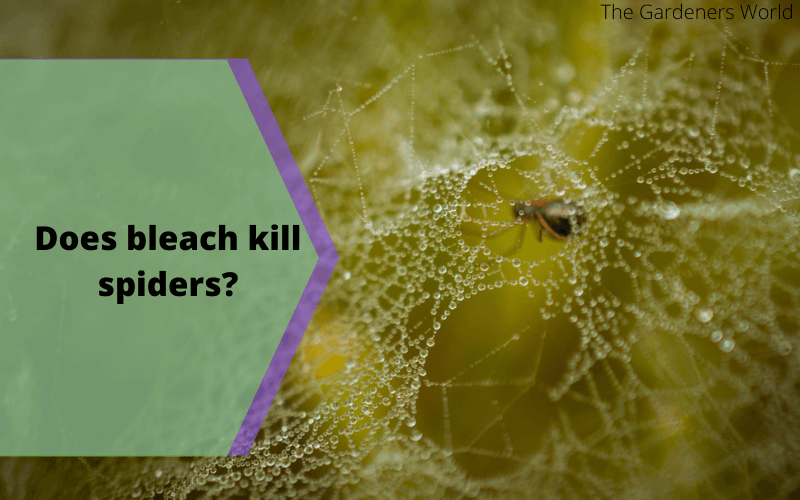
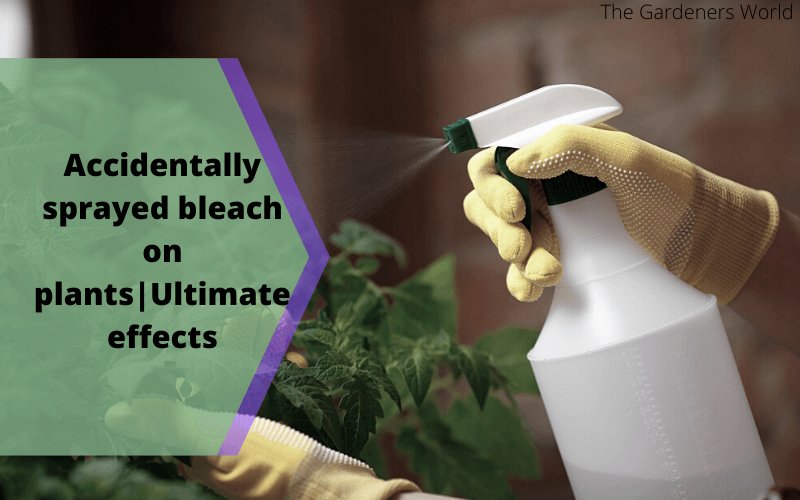
    The most asking question is how we can kill spiders? Or does bleach kill spiders? Yes, bleach can kill spiders very well. Bleach is considered a pesticide and fungicide due to its ability to kill bacterial cells. The acid on bleach kills the spiders and plants as well. Bleach can also kill other household pests including spiders. This isn’t a proper way to kill spiders or other pests with bleach as bleach can be harmful to humans and the surface it will spray. If you accidentally spray bleach to any plants you are going to kill the plants. 

    Let’s see how you can kill a spider with bleach.

    Let’s see how you can kill a spider with bleach

    Step 1: Mix one part of bleach with three parts of water. For example, if you take 50ML o water you can take 15-20 ML of bleach. After that mix them and fill them in a spray bottle.

    Step 2: Directly spray the mixer on spiders at a 5-10 inch range. If the spider is big spray much to kill the spider. The amount depends on the size of the spider.

    Step 3: The spider will be dead soon. Check after sometimes and throughout the dead spider. Also, clean the surface you have sprayed. 

    Step 4: For better results spray the bleach on the spiders’ nest and every corner of your house. You can repeat the process after a couple of weeks to remove the spiders permanently. 

    Don’t try to kill any spiders that are on your plants. You can read this if you accidentally spray bleach on your plants.

    Accidentally sprayed bleach on plants 

  • Underwatered Snake Plant | Symptoms and Prevention

    Underwatered Snake Plant | Symptoms and Prevention

    The most common problem with a snake plant is watering the snake plants. There are two chances of watering a snake plant overwatering snake plant and underwatered snake plant.

    Overwatered snake plant: By looking into the leaves you can identify if the plants are overwatered or not. Overwatering makes the leaves heavy and squishy. The leaves can fall over if they are overwatered. You can check the soil with your finger and if you can access water the plants are overwatered.

    Underwatered snake plant: Another problem with a snake plant is underwatered. Underwatered means the plants are not getting enough water. This situation can interrupt the supply of necessary nutrients. You can identify the underwatered snake plants by following some common symptoms. Join me to identify the symptoms of underwatered snake plant.

    Symptoms of Underwatered Snake Plant

    Leaves Falling

    Leaves Falling

    If a snake plant doesn’t get enough water the leaves will fall over and will look lifeless. This will happen because the plant can’t prepare the necessary nutrients for lack of water. This makes the leaves bend down and you can identify that the plant is suffering underwater. 

    Leaves Edge Drying

    Dry leaves edge

    Due to underwatering the edge of leaves can be brown or dry. The plants can’t supply enough food to the leaves due to water lacking and they become brown or dry.

    Curly Leave

    Curly leaves

    If you find any curly leaves on your snake plants you need to worry about this. Due to underwatering the leaves can fold or twist in. This is definitely a symptom of underwatered snake plant.

    Slow Growth

    If your snake plants are growing too slow this can be for lack of watering. The plants are unable to supply enough energy due to underwatering which can hamper the plant’s growth.

    Soil is Dry

    dry soil

    If you see the potting soil is dey this means the plants aren’t getting enough water that they need. The soil is dry and this is a sign of underwatering.

    How to save underwatered snake plant

    If you can identify this issue in the first stage you can save your plants. If the leave getting brown you can stop them but you can’t remove those spots from the leaves. As long as you can ensure that the roots are healthy new pups will grow. The first thing is to identify the problem and take the necessary action as soon as possible. You can follow the below instructions to keep the plants alive.

    Regular Watering Practice

    Water the Snake Plant regular basis. Though snake plans do not need a lot of care, but during this condition, you need to care to save the plants. Dry soil interrupts the supply of essential substances to the plants. It is because the means of transportation water is missing. Meanwhile, excessive amounts of water can lead to root rotting. A damaged root can’t deliver nutrients to the plants. These tips will help you determine if it is time to water your plant. 

    • Check the moisture of the soil by touching it with your finger. Around one to two inches from the surface should dry out before watering again. 
    • Check the sound of the soil. Gif you tap the pot it will sound dull if it is still damp.
    • Check the weight of the pot. If the pot is lighter there is definitely less water.
    • Inspect the color of the potting mix. The soil will transition into light color if they are starting to dry. 

    Right environment

    The right environment will support the growth of the Snake Plant. Make sure that the plant is having sufficient light, correct temperature, and humidity. You can place the plants in a bright light area. Their leaves will just develop in a brighter area and will turn into solid dark green under low light conditions. The correct temperature will be 55°F to 85°F (13°C to 30°C) for the snake plants.

    Cut affected areas

    As I have already mentioned the damaged area of a snake plant will not recover. The proper care can stop this from getting worse. Leaves that have some firm and healthy parts can be trimmed. If you think that you need to cut half of the leaves which may look bad you can cut the whole. Please use a sterilized knife for this.

    Proper potting mix

    Make a proper potting mixing for affected plants. You can use heavy potting media as they don’t dry quickly. The mix needs to have vermiculite, composts, and builder sand or peat moss. This soil can easily drains and can keep the plant nutrients.

    Apply Fertilizer

    Provide your snake plant fertilizer after it recovers from the problem. Natural fertilizers are always the best as they improve the soil’s ability to store nutrients & water. Make sure don’t overfertilize and do not apply fertilizer to a dried-up snake plant.

  • Animals That Only Eat Plants | List of Herbivores Animals

    Animals That Only Eat Plants | List of Herbivores Animals

    What is an herbivore? Animals that only eat plants are called herbivores. Herbivores mostly eat plants to get energy. They need lots of energy to live for example cows, sheep and eat all day long to keep them active. Herbivores have evolved digestive systems which are capable of digesting large amounts of plans. The plants are high in fiber and starch, and they provide the main energy source for the herbivores as they need lots of energy. 

    We can classified herbivores into four groups

    • Frugivores
    • Granivores
    • Nectivores
    • Folivores

    Frugivores

    mostly eat raw fruits. Approximately 20% of the mammalians are frugivores and they eat fruit. Frugivores not only eat fruits they also eat leaves and seeds, but they mostly eat fruit. Some frugivores are Chipmunk, Chimpanzee, Lemur, Gibbon.

    Granivores

    Granivores are also known as seed predation as they eat seeds. Most of the granivores are birds such as Parrot, Finches, Quail & Doves.

    Nectivores

    The species that eat honey are called nectivores. Most of the birds are nectivores in addition there are some insects that are nectivores. 

    Folivores

    Folivores are the species that eat plants as their major food. Elephants, sloths, some monkeys are folivores. Join us to find out some animals that only eat plants.

    Animals That Only Eat Plants

    Deer

    Is deer herbivore? Yes, deer is an herbivore as the main diet of a deer is plants including fruits, nuts and twigs, weed, mushrooms, and moos. A deer usually ear approximately two pounds of plants a day. The digestive system of a deer isn’t that good. A deer can’t eat over food as this can cause enterotoxemia. Different types of deer have different diets. Also, you will be surprised to know that some deer eat meat like other herbivores but this is a very uncommon behavior of a deer.

    Deer

    Classification of deer:

    Kingdom: Animalia 

    Phylum: Chordata 

    Class: Mammalia 

    Order: Artiodactyla 

    Infraorder: Pecora 

    Family: Cervidae

    Cow

    Cows are examples of herbivores. The main diet of a cow are plants. Cows eat plants and get energy from them. The stomach of a cow is different from other animals. Their stomach is made of four parts and they have different rules to process the food for the cow.

    The digestive system of a cow can only process plants. If you feed cow meat they might get sick. The unique digesting system made them great herbivores.

    The key reason cows are herbivores:

    • Their digestive systems are designed for digesting grass and foliage
    • Their teeth are dull and designed to process plants, not tough meat.
    COW

    Classification of cow

    ​​Kingdom: Animalia 

    Phylum: Chordata 

    Class: Mammalia 

    Order: Artiodactyla 

    Family: Bovidae 

    Subfamily: Bovinae 

    Genus: Bos 

    Species: B. taurus

    Elephant

    The main diet of an elephant are roots, grass & fruit. An adult elephant can eat up to 300 pounds of food in a day which is necessary for its huge body. An elephant doesn’t sleep that much as they need to have a large amount of food for their huge body. African elephants are the biggest elephant in the plants. Asian elephants are also big but they are slightly smaller than African elephants. An elephant can live up to 70 years and the estimated weight of an elephant is around 2.5 tons. For their diet habit elephants are considered an herbivore.

    Elephant

    Classification of an elephant:

    Kingdom: Animalia 

    Phylum: Chordata

    Class: Mammalia 

    Order: Proboscidea 

    Family: Elephantidae 

    Subfamily: Elephantinae

    Goat

    We are all familiar with goats as they are domestic animals. Also, most of us are also aware of the food habit of a goat. The main food of a goat is green grass. This is enough to make a goat herbivore. Some of the mountain goats eat mosses besides grass but still, they are herbivores. Gots stomach is the same as a cow with 4 chambers. 

    Domestic goats can be found all over the world, but the mountain goat can be found in the Rocky Mountains in Alaska, western Montana, South Dakota, Colorado & Washington.

    Goat

    Classification of a goat:

    Kingdom: Animalia 

    Phylum: Chordata 

    Class: Mammalia 

    Order: Artiodactyla 

    Family: Bovidae 

    Subfamily: Caprinae 

    Genus: Capra 

    Species: C. hircus

    Horse

    Horses are naturally grazer and their main diet is grass hay or haylage. They must consume lots of fiber to keep their digestive tract working and they must eat little and often, almost all day long. People usually keep the food bucket near their horse as they eat after sometimes a wild horse can graze for 15-17 hours per day. Now we can say that horses are herbivores.

    Horse

    Classification of a horse:

    Kingdom: Animalia 

    Phylum: Chordata 

    Class: Mammalia 

    Order: Perissodactyla 

    Family: Equidae 

    Genus: Equus 

    Subgenus: Equus 

    Species: E. caballus

  • 10 Examples of Flowering Plants

    10 Examples of Flowering Plants

    Every morning, When I step into my garden, I am welcomed by an extravagance of color. You can’t imagine the joy I find when I look at my flowering plants. And no matter what I’m going through, these flowers never fail to bring a smile to my face.

    So, if you want to start a garden, it’s important that you learn about some beautiful flowers, and today I’ll introduce you to some beautiful examples of flowering plants.

    You might not be familiar with some of them. But we’ll give all the key info about these flowers here for you.

    Flowering Plants

    If your plant bears flowers, it can be called a flowering plant AKA angiosperm. The main job of a flower is to help the plant reproduce. And a plant will produce flowers only during the flowering season. While some flowers can be eaten as vegetables, most of them are produced due to their mesmerizing beauty and the ability to liven up one’s mood.

    Nonflowering plants

    As it’s easy to guess from the name, any plant that fails to come up with flowers & seeds, they can be termed as nonflowering plants. You may see a few nonflowering plants producing seeds by using spores.

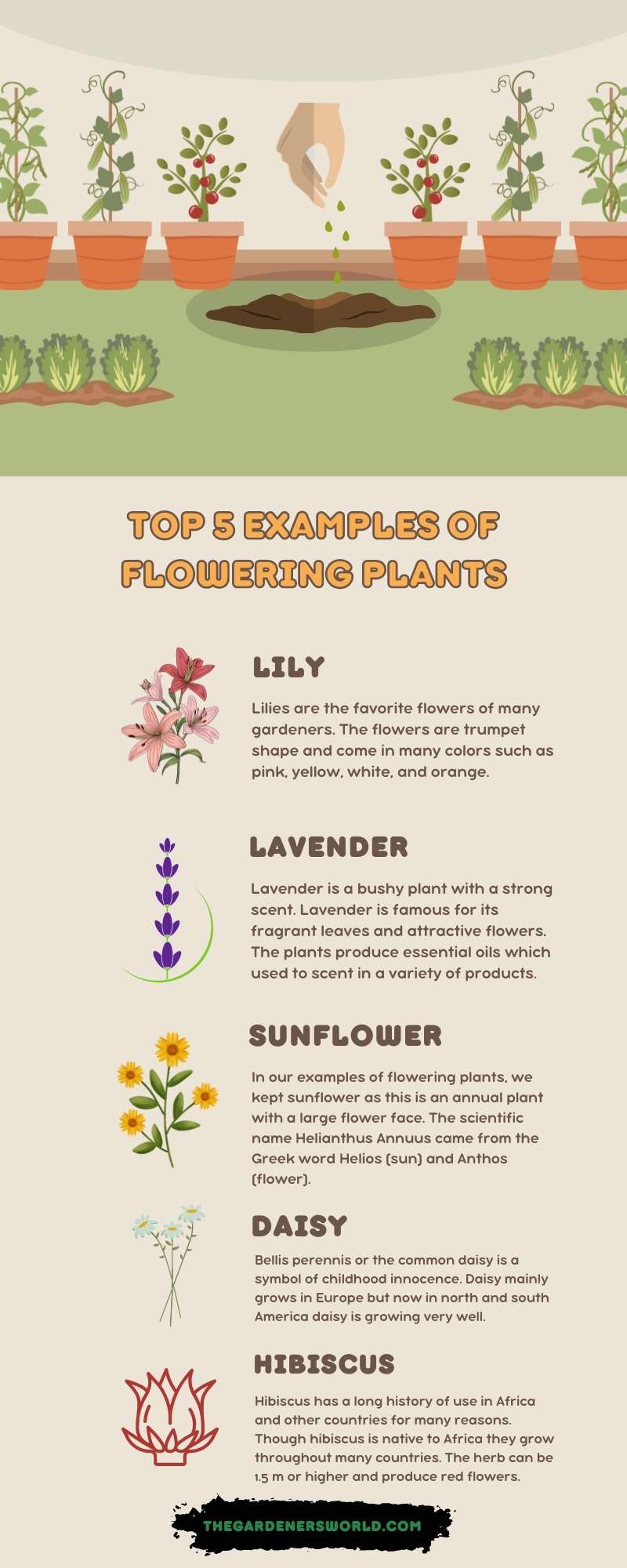
    An infographic of Top 5 Examples of Flowering Plants

    10 Examples of flowering plants

    1: Lily

    2: Lavender

    3: Sunflower

    4: Daisy

    5: Hibiscus

    6: Jasmine

    7: Water Lily

    8: Orchid

    9: Ixora

    10: Mango

    1. Lily

    Lily

    Classifications:

    Scientific name: Lilium

    kingdom: Plantae 

    Clade: Monocots 

    Order: Liliales 

    Family: Liliaceae 

    Subfamily: Lilioideae 

    Genus: Lilium

    Ask any gardener for their favorite pick, and they will choose lily first. From the first look, you’ll notice that the flowers are of trumpet shape and come in many colors such as pink, yellow, white, and orange. They are large dazzling flowers that come with a sweet scent like no other. Lilies have almost 100 species and hundreds of hybrids.

    I like that the stems of the flower are very sturdy and can be 2 to 6 feet. Lilies have six plain or strikingly marked tepals. Lilies are hard to identify, the true lily grows in from onion-like bulbs, are true perennials, and share characteristics of their flowers. 

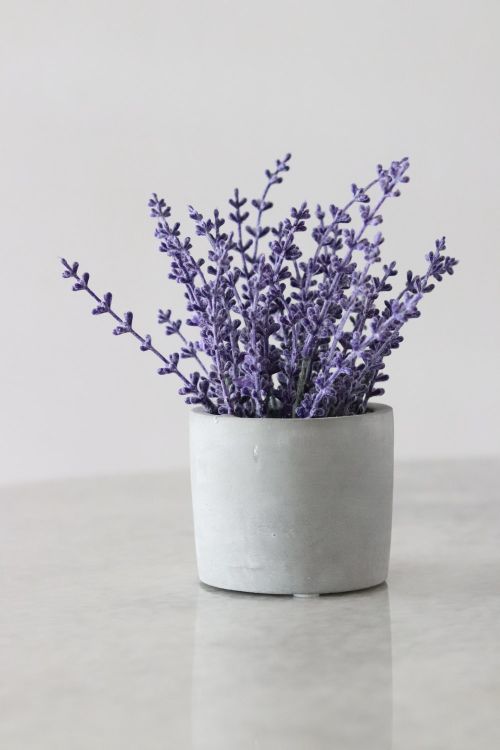
    2. Lavender

     Lavender

    Classifications:

    Kingdom: Plantae 

    Clade: Tracheophytes 

    Order: Lamiales 

    Family: Lamiaceae

    Subfamily: Nepetoideae 

    Genus: Lavandula 

    Lavender is a bushy plant with a strong scent. Lavender is famous for its fragrant leaves and attractive flowers. The plants produce essential oils which used to scent in a variety of products. The ancient Romans used lavender in their bath for fragrance. Lavender can survive in a wide range of solids, even they can grow in poor soil. They required lots of sunlight and good water drainage. Lavender also has some health benefits such as insomnia, skin treatment, reduced blood pressure, hair growth, etc.

    3. Sunflower

    Sunflower

    Classifications:

    Scientific name: Helianthus

    Kingdom: Plantae 

    Order: Asterales 

    Family: Asteraceae 

    Subfamily: Asteroidea 

    Genus: Helianthus

    When I began planning for my garden, there was no doubt about my first plant. It’s no other than sunflowers. It’s breathtakingly beautiful and can make any garden brighter. They also attract a lot of pollinators.

    Also, you can eat the seeds of these flowers by roasting them.

    When I first found out that, sunflowers are around 5000 years old, I was really surprised. But this annual plant hasn’t lost any charm over the years. Apart from the famous yellow, you can find them in red, white, orange, or bronze.

    4. Daisy

    Daisy

    Classifications:

    Scientific name: Bellis perennis

    Higher classification: Bellis

    Rank: Species

    Family: Asteraceae

    Kingdom: Plantae

    Order: Asterales

    If I ask you to imagine Bellis, what image would you conjecture in mind? White petals surrounding a yellow center? Then your imagination is pretty perfect. If you look beyond the beauty of this flower, you’ll get to notice many interesting stuff. For example the flower is a combination of lots of small flowers. They are called florets.

    And thanks to these small flowers, they don’t require any pollinators for reproduction.

    Another thing that should be brought to your notice is that Bellis is a member of the aster family, which is famous for producing a lot of toxic plants. This flower is also seen as a sign of innocence.


    5. Hibiscus

    Hibiscus

    Classifications:

    Scientific name: Hibiscus rosa-sinensis

    Kingdom: Plantae

    Order: Malvales

    Family: Malvaceae

    Subfamily: Malvoideae

    Genus: Hibiscus 

    When you first look at the Hibiscus, the first thing that attracts your attention is its big flower. And I’m certainly not complaining as I’m personally a huge lover of big flowers. There’s no shortage of options when it comes to colors, so, you can easily make your pick. Some are of the opinion that it has properties helpful to medical issues and thus often used for treating minor diseases

    6. Jasmine

    Jasmine

    Classifications:

    Scientific name: Jasminum

    Kingdom: Plantae

    Order: Lamiales 

    Family: Oleaceae

    Genus:  Jasminum L. 

    Jesmin is an exotic source of fragrance around the world. Jesmin needs full sunlight to grow. All jasmine isn’t fragrant but the most common jasmine produces fragrance. Flowering in jasmines takes six months after planting. Jasmines grow well in moist, well-drained, sandy, garden soil.

     7. Water Lily

    Water Lily

    Classifications:

    Scientific name: Nymphaeaceae

    Kingdom: Plantae

    Clade: Angiosperms

    Order: Nymphaeales

    Family: Nymphaeaceae

    Genus: Nymphaea L.

    Water lily is a floating plant with large, fragrant, white, or pink flowers. The leaves are round and floating as well. The leaves are bright green with long stems. You can see the water lily flower from morning until noon. Water lily is very beneficial for fish, they provide food for fish. The flowers are mostly 7.5-12.5 cm. The center has one pistil with bright yellow stamens. The water lily can be found on 5-7 feet deep water like ponds and other water sources with silty and, mucky beds.
    8. Orchid

    Orchid

    Classifications:

    Scientific name: Orchidaceae

    Higher classification: Asparagales

    Rank: Family

    Family: Orchidaceae; Juss.

    Kingdom: Plantae

    It’s believed by many that the orchid represents luxury, beauty, and strength. The Greek women of pre-historic times were of the opinion that if they consumed mini orchid tubers, they would be blessed with a girl. Also if the father ate large orchid tubers the child will be a boy. Obviously, they have no scientific basis and have been proven false.

    You’ll find no less that 20000 species of orchids all over the world. Orchid is the biggest family in the flowering plants  Orchid is also known as Orchidaceae which is the scientific name of orchid. Orchid is diverse, having a variety of colors, shapes, and sizes.

    Cattleya, cymbidium, dendrobiums, phalaenopsis, and vanda are some of the common orchids. Few types of orchids are grown for consumption vanilla, the extracts are made into a food flavoring.

    9. Ixora

    Ixora

    Classifications:

    Scientific name: Ixora

    Kingdom: Plantae

    Order: Gentianales

    Family: Rubiaceae

    Subfamily: Ixoroideae

    Genus: Ixora L.

    I wanted a flowering plant that didn’t occupy all my time for maintenance. And Ixora fit the bill perfectly, as it’s a very low-maintenance plant. With bare minimum care, it will grow and take your garden’s aesthetics to the next level.

    The flower comes from the Rubiaceae family and is readily available in sub-tropical countries. Most of them grow 6-8 ft, but some of them can reach as much as 13 ft.

    10. Mango

    Mango

    Classifications:

    Mangifera indica

    Kingdom: Plantae

    Order: Sapindales

    Family: Anacardiaceae

    Genus: Mangifera

    Species: M. indica

    Is it possible to not love mango? certainly not. But you might not be aware that the mango tree produces some amazing flowers that are beautiful to look at. So, before it starts producing the mangoes, make sure you enjoy the flowers of the tree.

  • Are Plants Multicellular | Plants Cell Structure

    Are Plants Multicellular | Plants Cell Structure

    Are plants multicellular?

    The answer is a resounding yes. Because plants are made of multiple cells. And each cell has a very particular job to complete. 

    All the cells have organelles that do a specific task to help the cell function. To give an example, the nucleus controls what’s going on inside the cell, while chloroplast deals with using sunlight to create food for the plant. And there’s also a nuclear membrane to keep all the organelles together. 

    Now, all the cells can communicate between them to keep the plants growing and surviving. And since each of them has unique specialties, they can be a bit difficult to understand initially. 

    Nevertheless, overall, it can be said without any doubt that plants are multicellular. 

    How Plants Grow And the Cell Division Process

    As we’re aware already, multicellular organisms like plants grow by dividing their cells. But what is cell division? It’s a very special process where a cell splits into two or more cells. This method of cell division is absolutely vital for the continuous growth of plants. Plant cells can split up in various ways, which will be decided by the nature of the cell. 

    However, most cells use the mitosis method for cell division. That said, some can use miosis as well. DNA has a vital role in the cell division process as the cell starts to divide only when the DNA is replicated. In the initial stage, the chromosomes will come and take place in the center. After that, the cell will split into 2 parts. Both parts will contain a chromosome each. The spindle fibers in plant cells play an important role in ensuring that the genetic content remains separate. Then, a new cell gets birth from each of them. 

    It’s important to note that, cell division is no arbitrary process, and is closely controlled by the plant itself. The cells go through the division only when it’s required. Uncontrolled cell production by division will give rise to many problems and diseases. 

    Plant Cell Structure

    When it comes to the structure of plant cells, you’ll find it quite complex. It has many unique features that sets it apart from other types of cells.

    Anatomy of a plant cell:

    Cell wall

    Chloroplasts

    Endoplasmic Reticulum

    Nucleus

    Plasma Membrane
    Plant Cell Structure


    Cell wall:

    Cell wall

    The cell wall is a strong, rigid layer that protects it from damage. This part of the cell also comes in handy when maintaining the cell shape. It also becomes useful in controlling the nature of molecules getting inside and out of the cell. The wall is porous and facilitates the passage of small molecules, including water, oxygen, and nutrients. It allows plants to absorb water and nutrients from the soil.

    The elements of the plant cell wall feature cellulose, pectin, cross-linking glycan, plasma membrane, cellulose microfibrils.

    Chloroplasts:

    Chloroplasts

    You can find Chloroplasts in green plants. These are crucial for the photosynthesis process that makes it possible for the plants to create their own food.  An important thing is the density of chloroplasts as they’ll dictate the amount of photosynthesis that takes place. Chloroplasts contain inner membrane,  stroma, stroma lamellae, outer membrane, granum, and thylakoid.

    Endoplasmic Reticulum:

    Endoplasmic Reticulum

    The endoplasmic reticulum a network of membrane-bound chambers that are key for cellular function. It also takes part in processing and transporting several biochemical compounds inside and outside of the cell. 

    Nucleus

    Nucleus

    You’ll find this round organelle in all the plant cells without any exception. The duty of Nucleus is to control all the activities within the cell, including important tasks such as reproduction and cell division.  You’ll find contents Chromatin, Nucleolus, Ribosomes, Endoplasmic reticulum in nucleus.

    Plasma Membrane

    Plasma Membrane

    It is a thin, barrier that’s quite flexible as well. It borders the cells of all the plants. The plasma membrane kinda works like a guard, as it controls what will go in and out of the cell. It’s made with phospholipid bilayer, with proteins embedded in it.

    Comparison Between Unicellular and Multicellular Organisms

    There are many differences between them. We’ll discuss these differences here. 

    Number of Cells

    The main difference between unicellular and multicellular organisms is the number of cells they contain.

    Unicellular organisms are single-celled, on the other hand, multicellular organisms are composed of many cells.

    Complexity

    Multicellular organisms are more complex, and can carry out more complex functions than unicellular organisms.

    For example, multicellular organisms can move, whereas unicellular organisms generally cannot.

    Multicellular organisms can also have specialized cells that perform specific functions, whereas unicellular organisms usually do not.

    Size

    Multicellular organisms are generally larger than unicellular organisms.

    Are There Any Advantages of being Multicellular?

    Yes, there are numerous advantages. They are:

    • Helps with efficient nutrient uptake

    multicellularity allows for a greater surface area to volume ratio, which means that there is more surface area available for the absorption of nutrients.

    • The ability to specialize in different functions

    Some cells may be specialized for the absorption of nutrients while others are specialized for the excretion of waste products. This division of labor makes the entire system more efficient.

    • Protection from predators and the environment

    Multicellularity offers protection as specialized cells can form barrier tissues that protect the organism as a whole. And individual cells are less likely to be damaged or destroyed when surrounded by other cells. It also enables organisms to grow much larger than single cells, which increases their chances of survival in a tough environment.

  • Accidentally Sprayed Bleach On Plants | Ultimate Effects

    Accidentally Sprayed Bleach On Plants | Ultimate Effects

    Bleach is a chemical product that is used to cleaning or remove the color from fabric. 

    What if someone accidentally sprayed bleach on plants? 

    Three types of bleach

    types of bleach

    Chlorine bleach: Chlorine bleach contains sodium hypochlorite. Chlorine bleach used for generations to disinfect all kinds of environmental surfaces. This bleach can be used to prevent the spread of diseases. 

    Oxygen bleach:  Oxygen bleach usually contains hydrogen peroxide such as sodium perborate or sodium percarbonate. This is used to removes stains and brightens.

    Bleaching powder: Bleaching powder is basically calcium hypochlorite. Bleaching powder is used for cleaning dirty clothes in the laundry. Also, it is used as a disinfectant to make potable water.

    Sprayed bleach on plants

    Bleach will not affect your plant’s growth. But if you accidentally sprayed bleach on plants they may suffer from chlorine toxicity and may die. 

    Effects on soil 

    As bleach works well for the cleaning process this will kill many necessary organic materials like bacteria and fungi which provide aeration in the soil. Those bacteria and fungi are very important for healthy plants to grow. If they are being killed the plants will die very soon. 
    Also bleach decrease the PH level of the soil and plants can’t grow and survive after applying bleach. 

    Effects on Leaves 

    Affect on bleach

    If the bleach is sprayed on leaves they will turn white color very quickly. Bleach will burn the cells of leaves and oxygen will combine with cell protein which causes a quick decompose. The leaves will die very soon. Leaves are the primary source of photosynthesis. The plants feed themselves in this photosynthesis process. This process turns sunlight into sugars which helps plants to grow and survive. If the leaves of your plants got affected the plants will die very soon. 

    What to do to minimize the damage

    If accidentally bleach sprayed remove the plants quickly with a little soil. Plant them in another safe place. 

    You need to rinse your plants immediately with clear water. The water will wipe the bleach and prevent the leaf from scorching. 

    Remove the affected parts of the plants if the plant got affected directly.

    You may like to read: Does bleach kill spiders