Category: Flowering Plants

  • What Is Nardos Flower? Origin, Uses, Care & Facts

    What Is Nardos Flower? Origin, Uses, Care & Facts

    Nardos flowers, commonly known as Tuberose, are very commonly found. They’re also one of the most widely used flowers in making bouquets. Sadly, despite their popularity, most people don’t know them well.

    In this article, we’ll discuss the morphology, history, and key facts about Nardos flowers. We’ll also discuss how you can grow and use these flowers. So, let’s get started!

    What Is Nardos Flower?
    What Is Nardos Flower

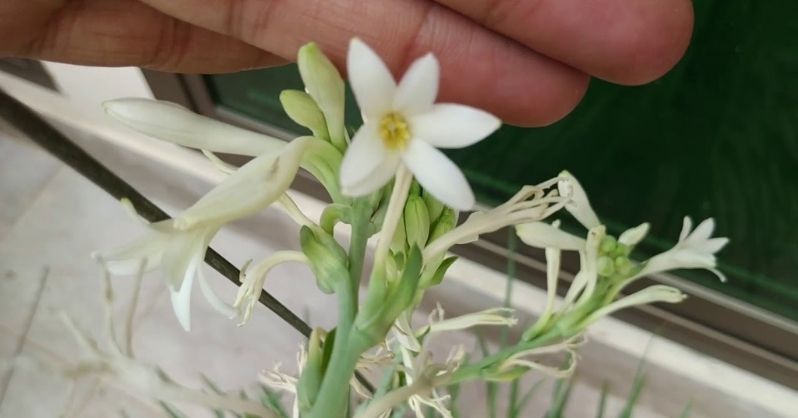
    Scientifically known as Polianthes tuberosa, the Nardos is a very beautiful flower. Although it’s called Tuberose commonly, it’s also called by beautiful names such as Nardo, Nardos, Amoles or Vara de San Jose, meaning St. Joseph’s staff. In South Asia, it’s called Rajanigandha, meaning “Fragrance of night”.

    The genus of this flower is Polianthes under the class Monocot, which in turn, falls under Amaryllidaceae.

    Although the plant can be up to a meter in height, certain variants are known to grow taller. Each stalk of Nardos comes with a cluster of flowers, and each flower can grow up to 30 cm in height. In some cases, the flowers grow as long as 45 cm. Nardos flowers can be either white or pink, depending on the sub-species.

    Where Does Nardos Flower Come From?

    These flowers originate from Mexico. These plants grow well in cool and tropical climates, and Mexico provides the perfect environment for them to grow.

    Other than Mexico, these flowers are known to grow well in the Indian sub-continent as well. Although the climate is a bit different than that of Mexico, it’s suitable enough for Nardos. Hence, this flower is abundantly used in these regions.

    How Can You Use the Nardos Flower?

    How Can You Use the Nardos Flower

    Nardos flowers are mainly used for decorative purposes. One of the prime features of these flowers is that they aren’t only pretty, but they have a beautiful scent as well. Due to their strong fragrance, they’re used for making perfume as well.

    One lesser-known side of this flower is its medicinal characteristics. It can help those afflicted by insomnia. Furthermore, it helps reduce stress. Consumption of Nardos is proven to be beneficial for the immune system, and it can also help with infections.

    Not only that, but these flowers are beneficial for reproductive health as well. Consumption of Nardo stem can reduce menstrual disorders. Furthermore, they are also great for fighting fungi.

    Despite these health benefits, it’s important to note that excessive use of these flowers can create adverse effects. So, they must be used or consumed in moderation if someone wishes to enjoy their health benefits.

    How To Grow Nardos Flower

    How To Grow and care and Nardos Flower

    Nardos flowers have high adaptability, and they can be grown equally well in tropical and cold climates. In this article, we’ll discuss all the factors that’ll help you grow Nardos flowers with the least hassle.

    Choose the Right Location

    Choose the Right Location for tuberose flower

    Nardos flowers are grown from their bulbs. To ensure the flower grows properly, you need to ensure an optimum environment for its growth. Start by picking the right location and season.

    As for choosing the right spot, you need to pick a space that gets adequate sun and has good soil for the development of roots. While you plant the bulbs, make sure there’s at least a 20cm gap between each of them.

    When to Plant?

    The best time for planting Nardos would be early spring. To be precise, the temperature must be warm when you plant the bulbs, and it’s best if the humidity ranges from 60% to 70%. If planted in early spring, you can see the flowers blooming in late spring.

    Soil Condition

    Nardos flowers aren’t particularly adaptive in terms of soil pH, so it’s best if the pH is kept at 7. Plus, the soil must have essential nutrients for the growth of the flowers. To ensure proper nutrition, you can fertilize the soil using organic fertilizer.

    Drainage System

    While Nardos flowers can grow without a perfect drainage system, it’s important to make sure water doesn’t stagnate on the bed. Accumulation of excess water will make the bed muddy, thus leading to root rot and bacterial and fungal growth.

    Fertilizer

    As we’ve discussed earlier, the soil must be fertilized for optimum growth of the Nardos flowers. To ensure proper fertilization, we highly recommend using the 8-8-8 fertilizer.

    These fertilizer packs come with equal parts of phosphorus, nitrogen, and potassium. This combination is very healthy for bulbous plants like Nardos. Moreover, you can ask the local nursery for fertilizers specially made for this kind of plant.

    You don’t have to fertilize these flowers regularly. Doing them once every six months will be more than enough.

    Prune Dead Stalks and Flowers

    If you ever come across a dead flower or stalk, we recommend pruning it instantly. Even if you find the stalk yellowing out, it’s recommended that you prune it. Pruning the dying or dead components will encourage healthy growth. This is especially true for the growing season.

    So, we recommend you get a set of scissors every morning and tend to the flowers. This will help you achieve a garden full of healthy Nardos flowers.

    Key Facts About Nardos Flower

    • These are perennial plants, which is why they’re highly preferred by people who’re looking for long-term plants.
    • These flowers can withstand down to -2 degrees Celsius, making them appropriate for cold climates as well.
    • These flowers can help with insomnia, stress, digestive problems, menstrual cramps, and much more.
    • Due to their strong fragrance, they’re often used for the preparation of perfume and fresheners.

    Conclusion

    Nardos flowers aren’t rare by any means, but the layers of benefit they offer isn’t common knowledge. Hopefully, this article provided all the information necessary to grow and care for Nardos flowers.

    Furthermore, we’ve also tried to delineate the benefits of these flowers and how you can use them. With this information at hand, we hope that you’ll be able to put these flowers to the best use!

    Related Posts:

    10 Examples of Flowering Plants

    What Is Azucena Flower? Origin, Uses, Care & Facts

    White Orchid: Learn Everything About the Elegant and Mysterious Flowers

    Blue Orchid: Everything About the Exotic Flower

    Red Orchid: All You Need to Know About the Fascinating Flower   

  • What Is Azucena Flower? Origin, Uses, Care & Facts

    What Is Azucena Flower? Origin, Uses, Care & Facts

    Is the name Azucena throwing you off guard? This rarely used name may give you the impression that you’ve never heard of this flower, let alone seen it. However, you’ll be surprised to know what it’s commonly called.

    The Azucena flowers are commonly referred to as Lily, but they’re essentially only a genus of Lily. Lilum Candidum, or Madonna Lily, are called Azucena flowers. In this article, we’ll discuss this flower more. So, let’s get right to it and learn some interesting facts.

    What Is an Azucena Flower?

    What Is an Azucena Flower

    Azucena is the Spanish name for Madonna lilies. It is essentially herbaceous tuberose. They belong to the Lilium genus and Liliaceae family. These plants grow up to 50 cm or 1.5ft. long. Their bases grow up to 13mm in width.

    These tubular flowers have a 6cm tube that ends with six petals at the end. One of the striking characteristics of Azucena flowers is their fragrance. Other than that, these have six stamens protruding from the tube. The stigma is divided into three parts.

    The History of The Azucena Flower

    The History of The Azucena Flower

    Although much can’t be found about the history of this flower, certainly, they were first recorded about 3,000 years back. This makes Azucena flowers the first-ever documented lilies to exist. Although, that doesn’t necessarily mean that these are the most ancient ones. 

    The Meaning of The Azucena Flower

    Like every other flower, the Azucena flowers come with an identity of their own. The first part of their scientific name, which is Lilium, is made up of two Latin words. The first part, Li, is a Latin word for white. Secondly, Ilium is a Latin word for flower.

    The second word, Candidum, also carries a meaning. It means shining or dazzling white. So, Lilium Candidum stands for Shining white flower if put together.

    How To Grow This Flower?

    How To Grow Azucena Flower

    There are multiple steps to growing an Azucena flower. Moreover, caring for this is just as important as growing it. In this section, we’ll be going over all of those.

    Decide a Time for Plantation

    Firstly, you need to decide the right time for planting an Azucena flower. They can’t withstand winter, so it’s important to plant them right after winter. This will help them last the longest.

    One more thing to note is that Azucena flowers don’t do well in cold climates. Even in warm weather, they’ll require at least four months to mature. If you live in a cold climate, you can plant the flower indoors first. Once they’re mature enough, transfer them outside.

    Soil Preparation

    Azucena flowers need proper soil preparation for optimum growth. The first thing you should work on is ensuring proper drainage. Next up, work on adding as much nutrition to the soil as possible.

    To do this, you can add compost, manure, or moss into the soil. These organic fertilizers are best for nutrition supply. You need to apply a mixture of all the said items at least 3 cm thick above the soil. This also helps with the drainage solution.

    However, if you don’t want to raise the soil bed, you can use a draining pot instead. These flowers can adapt to different levels of pH. Although they can withstand down to 5.5 pH, it’s optimum to keep it around 6.5 or 7.

    Azucena Flowers Love the Sun

    Azucena is a long day flower and loves the sun. You need to plant them in an area that has sun exposure for at least six hours a day. As these are more suitable for warm climates, planting them in partial or complete shade will only dry them out.

    Water the Plant Appropriately

    Before the plant emerges from the seed, you should water it only when necessary. Overwatering in this stage will prevent germination. Once the plant appears above the soil, it’s an indication that it has a developed root system. Thus, it’ll be able to handle more water.

    Even during the growing season, it’s not necessary to water it too much. Ideally, filling the plant bed with 3cm of water every week would suffice. Instead of watering frequently, water it once a week.

    In case of heavy downpours, reduce the frequency of watering or don’t water at all. Overwatering will cause root rot as these plants are prone to such diseases.

    Fertilize As Per Necessity

    If you want your Azucena flowers to bloom with all of their glory, then it’s wise to fertilize them appropriately. We highly recommend applying 8-8-8 fertilizers on them. These come with an equal part of phosphorus, nitrogen, and potassium.

    The fertilizer needs to be applied around the plant once every 40 days. If it’s solid, you need to spread it on the soil around the plant. In the case of liquid fertilizers, you just need to follow the instructions.

    Prune Dead Flowers

    In the growing season, you will come across dead flowers. Pruning the dead flowers will facilitate the growth of new flowers. So, we highly recommend pruning dead flowers weekly.

    Facts About the Flower

    Here are some facts about Azucena flowers that might interest you:

    • These flowers have been grown since ancient times because of their adaptability. They aren’t particularly picky when it comes to soil pH or type. It’s also very easy to maintain or care for them.
    • Azucena flowers were used as medicinal items in ancient medical treatments.
    • These plant seeds don’t last if stored for a long time. This is due to the absence of a thin covering that’s present in every other bulbous plant.
    • There’s a ton of mention of Azucena flowers in religion and poems. They were mostly used to symbolize purity.
    • It’s scientifically proven that Azucena flowers have health benefits that help combat diabetes, cancer, and heart diseases.  

    What’s The Origin of This Flower?

    What’s The Origin of Azucena Flower

    It’s not possible to trace back the actual origin of Azucena flowers due to a lack of information. What we know is these beautiful lilies used to grow in Southern parts of Europe and Asia in abundance.

    Due to their beautiful appearance, low maintenance, and high adaptability, they became famous all across the globe.

    Conclusion

    As you can see, Azucena flowers have a glorious history, and since the ancient days, they have been hailed as the symbol of purity. Planting these in your backyard or your home would not only beautify your place but would also bring a sense of serenity.

    Related Posts:

    10 Examples of Flowering Plants

    What Is Nardos Flower? Origin, Uses, Care & Facts

    White Orchid: Learn Everything About the Elegant and Mysterious Flowers

    Blue Orchid: Everything About the Exotic Flower

    Red Orchid: All You Need to Know About the Fascinating Flower

  • 10 Examples of Flowering Plants

    10 Examples of Flowering Plants

    Every morning, When I step into my garden, I am welcomed by an extravagance of color. You can’t imagine the joy I find when I look at my flowering plants. And no matter what I’m going through, these flowers never fail to bring a smile to my face.

    So, if you want to start a garden, it’s important that you learn about some beautiful flowers, and today I’ll introduce you to some beautiful examples of flowering plants.

    You might not be familiar with some of them. But we’ll give all the key info about these flowers here for you.

    Flowering Plants

    If your plant bears flowers, it can be called a flowering plant AKA angiosperm. The main job of a flower is to help the plant reproduce. And a plant will produce flowers only during the flowering season. While some flowers can be eaten as vegetables, most of them are produced due to their mesmerizing beauty and the ability to liven up one’s mood.

    Nonflowering plants

    As it’s easy to guess from the name, any plant that fails to come up with flowers & seeds, they can be termed as nonflowering plants. You may see a few nonflowering plants producing seeds by using spores.

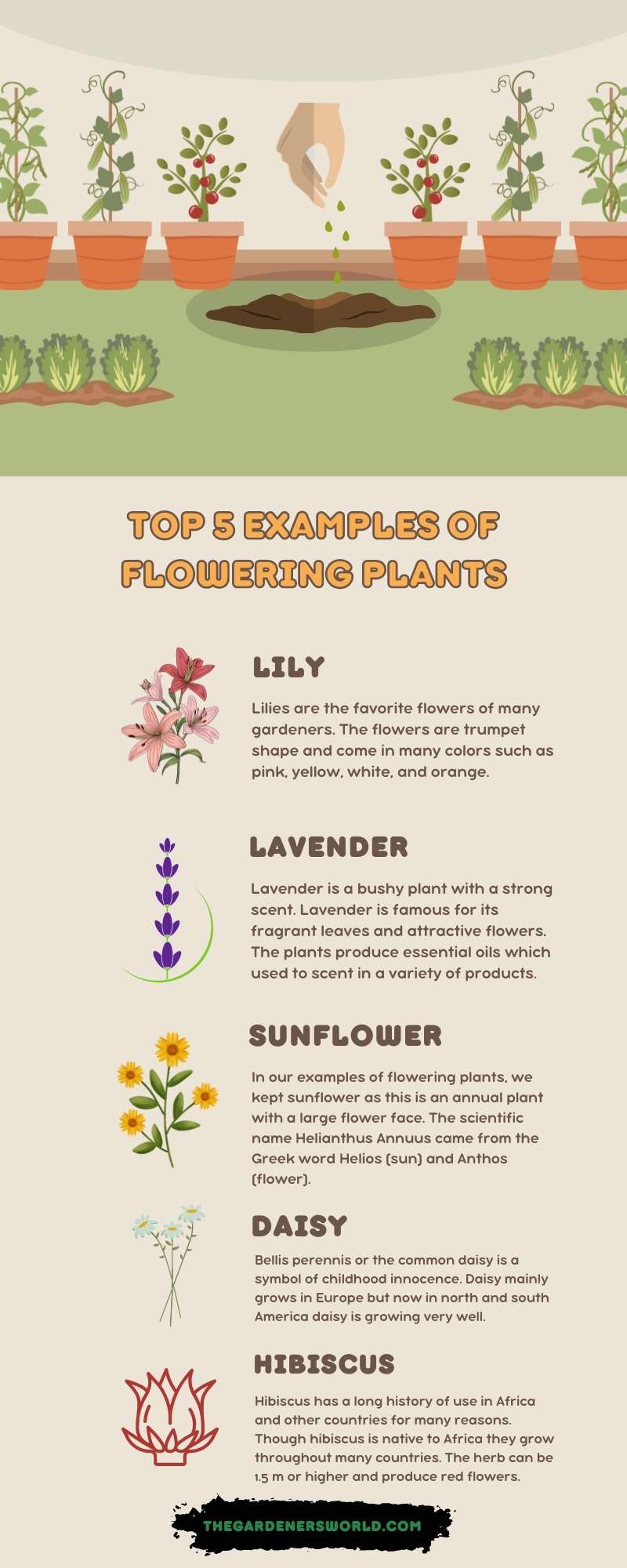
    An infographic of Top 5 Examples of Flowering Plants

    10 Examples of flowering plants

    1: Lily

    2: Lavender

    3: Sunflower

    4: Daisy

    5: Hibiscus

    6: Jasmine

    7: Water Lily

    8: Orchid

    9: Ixora

    10: Mango

    1. Lily

    Lily

    Classifications:

    Scientific name: Lilium

    kingdom: Plantae 

    Clade: Monocots 

    Order: Liliales 

    Family: Liliaceae 

    Subfamily: Lilioideae 

    Genus: Lilium

    Ask any gardener for their favorite pick, and they will choose lily first. From the first look, you’ll notice that the flowers are of trumpet shape and come in many colors such as pink, yellow, white, and orange. They are large dazzling flowers that come with a sweet scent like no other. Lilies have almost 100 species and hundreds of hybrids.

    I like that the stems of the flower are very sturdy and can be 2 to 6 feet. Lilies have six plain or strikingly marked tepals. Lilies are hard to identify, the true lily grows in from onion-like bulbs, are true perennials, and share characteristics of their flowers. 

    2. Lavender

     Lavender

    Classifications:

    Kingdom: Plantae 

    Clade: Tracheophytes 

    Order: Lamiales 

    Family: Lamiaceae

    Subfamily: Nepetoideae 

    Genus: Lavandula 

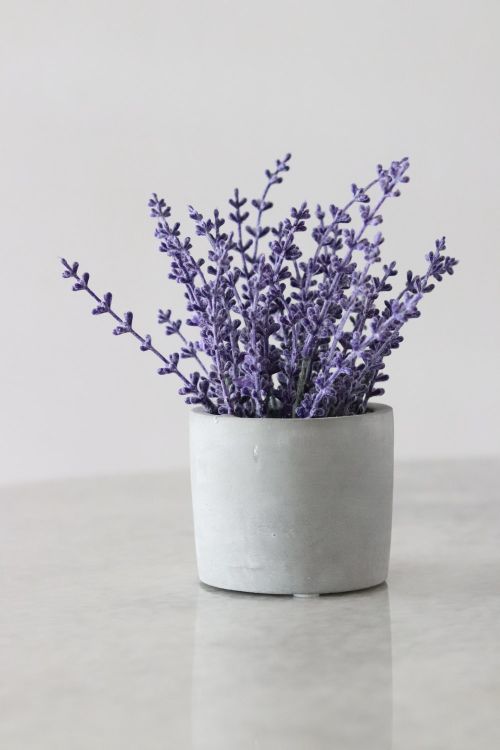
    Lavender is a bushy plant with a strong scent. Lavender is famous for its fragrant leaves and attractive flowers. The plants produce essential oils which used to scent in a variety of products. The ancient Romans used lavender in their bath for fragrance. Lavender can survive in a wide range of solids, even they can grow in poor soil. They required lots of sunlight and good water drainage. Lavender also has some health benefits such as insomnia, skin treatment, reduced blood pressure, hair growth, etc.

    3. Sunflower

    Sunflower

    Classifications:

    Scientific name: Helianthus

    Kingdom: Plantae 

    Order: Asterales 

    Family: Asteraceae 

    Subfamily: Asteroidea 

    Genus: Helianthus

    When I began planning for my garden, there was no doubt about my first plant. It’s no other than sunflowers. It’s breathtakingly beautiful and can make any garden brighter. They also attract a lot of pollinators.

    Also, you can eat the seeds of these flowers by roasting them.

    When I first found out that, sunflowers are around 5000 years old, I was really surprised. But this annual plant hasn’t lost any charm over the years. Apart from the famous yellow, you can find them in red, white, orange, or bronze.

    4. Daisy

    Daisy

    Classifications:

    Scientific name: Bellis perennis

    Higher classification: Bellis

    Rank: Species

    Family: Asteraceae

    Kingdom: Plantae

    Order: Asterales

    If I ask you to imagine Bellis, what image would you conjecture in mind? White petals surrounding a yellow center? Then your imagination is pretty perfect. If you look beyond the beauty of this flower, you’ll get to notice many interesting stuff. For example the flower is a combination of lots of small flowers. They are called florets.

    And thanks to these small flowers, they don’t require any pollinators for reproduction.

    Another thing that should be brought to your notice is that Bellis is a member of the aster family, which is famous for producing a lot of toxic plants. This flower is also seen as a sign of innocence.


    5. Hibiscus

    Hibiscus

    Classifications:

    Scientific name: Hibiscus rosa-sinensis

    Kingdom: Plantae

    Order: Malvales

    Family: Malvaceae

    Subfamily: Malvoideae

    Genus: Hibiscus 

    When you first look at the Hibiscus, the first thing that attracts your attention is its big flower. And I’m certainly not complaining as I’m personally a huge lover of big flowers. There’s no shortage of options when it comes to colors, so, you can easily make your pick. Some are of the opinion that it has properties helpful to medical issues and thus often used for treating minor diseases

    6. Jasmine

    Jasmine

    Classifications:

    Scientific name: Jasminum

    Kingdom: Plantae

    Order: Lamiales 

    Family: Oleaceae

    Genus:  Jasminum L. 

    Jesmin is an exotic source of fragrance around the world. Jesmin needs full sunlight to grow. All jasmine isn’t fragrant but the most common jasmine produces fragrance. Flowering in jasmines takes six months after planting. Jasmines grow well in moist, well-drained, sandy, garden soil.

     7. Water Lily

    Water Lily

    Classifications:

    Scientific name: Nymphaeaceae

    Kingdom: Plantae

    Clade: Angiosperms

    Order: Nymphaeales

    Family: Nymphaeaceae

    Genus: Nymphaea L.

    Water lily is a floating plant with large, fragrant, white, or pink flowers. The leaves are round and floating as well. The leaves are bright green with long stems. You can see the water lily flower from morning until noon. Water lily is very beneficial for fish, they provide food for fish. The flowers are mostly 7.5-12.5 cm. The center has one pistil with bright yellow stamens. The water lily can be found on 5-7 feet deep water like ponds and other water sources with silty and, mucky beds.

    8. Orchid

    Orchid

    Classifications:

    Scientific name: Orchidaceae

    Higher classification: Asparagales

    Rank: Family

    Family: Orchidaceae; Juss.

    Kingdom: Plantae

    It’s believed by many that the orchid represents luxury, beauty, and strength. The Greek women of pre-historic times were of the opinion that if they consumed mini orchid tubers, they would be blessed with a girl. Also if the father ate large orchid tubers the child will be a boy. Obviously, they have no scientific basis and have been proven false.

    You’ll find no less that 20000 species of orchids all over the world. Orchid is the biggest family in the flowering plants  Orchid is also known as Orchidaceae which is the scientific name of orchid. Orchid is diverse, having a variety of colors, shapes, and sizes.

    Cattleya, cymbidium, dendrobiums, phalaenopsis, and vanda are some of the common orchids. Few types of orchids are grown for consumption vanilla, the extracts are made into a food flavoring.

    9. Ixora

    Ixora

    Classifications:

    Scientific name: Ixora

    Kingdom: Plantae

    Order: Gentianales

    Family: Rubiaceae

    Subfamily: Ixoroideae

    Genus: Ixora L.

    I wanted a flowering plant that didn’t occupy all my time for maintenance. And Ixora fit the bill perfectly, as it’s a very low-maintenance plant. With bare minimum care, it will grow and take your garden’s aesthetics to the next level.

    The flower comes from the Rubiaceae family and is readily available in sub-tropical countries. Most of them grow 6-8 ft, but some of them can reach as much as 13 ft.

    10. Mango

    Mango

    Classifications:

    Mangifera indica

    Kingdom: Plantae

    Order: Sapindales

    Family: Anacardiaceae

    Genus: Mangifera

    Species: M. indica

    Is it possible to not love mango? certainly not. But you might not be aware that the mango tree produces some amazing flowers that are beautiful to look at. So, before it starts producing the mangoes, make sure you enjoy the flowers of the tree.